

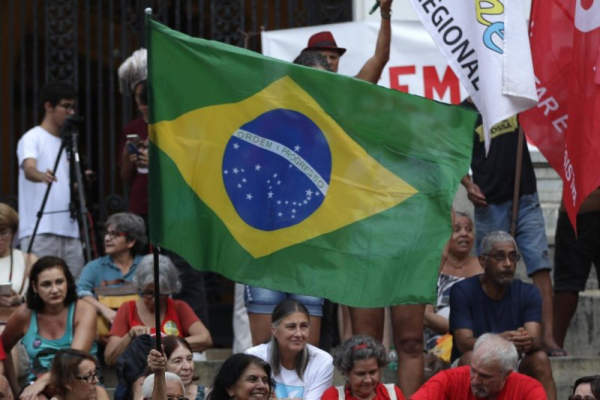
Latin America’s high cost of capital is driven by political risk and weak institutions. Brazil, the region’s largest economy, is the clearest example. File Photo by Andre Coelho/EPA
In earlier columns, I argued that Latin America’s high cost of capital is driven mainly by political risk and weak institutions. Brazil, the region’s largest economy, is one of the clearest examples.
The country has extraordinary scale, a domestic market of more than 200 million people, abundant natural resources and deep reserves of technical talent. Yet investors still demand a steep premium to operate there. That premium does not reflect a lack of potential. It reflects persistent doubts about the fiscal outlook, the complexity of the tax system and the state’s uneven capacity to implement policy efficiently.
Brazil’s benchmark Selic rate stands at 14.75% following the central bank’s March 2026 decision, one of the highest nominal policy rates among major economies. Public debt, which the IMF estimates at roughly 88% of gross domestic product, also remains elevated by emerging-market standards. The result is a financing environment that constrains investment, raises borrowing costs and narrows the country’s room to grow.
That is Brazil’s paradox. It is not short on assets. It is short on confidence.
What investors are watching
If the country wants to lower its cost of capital in a lasting way, it will need more than isolated adjustments. It will need a policy mix that persuades markets that the rules will be steadier and the fiscal path more credible, while also showing that reform can be sustained politically over time.
The first priority is fiscal discipline. Brazil has struggled for years with deficits that keep pressure on debt and interest rates. The key question is not whether the country needs outside supervision. It is whether its own fiscal framework can persuade investors that public accounts are moving toward a more reliable path.
That means controlling spending growth, improving compliance with fiscal targets, and demonstrating that debt stabilization is a real priority. If Brasília can do that credibly, borrowing conditions should gradually improve across the economy. That does not mean abrupt austerity at any cost. It means restoring confidence that the public accounts will not keep drifting.
The second priority is tax simplification. Brazil has already approved an important overhaul built around a dual value-added tax, but the transition period is long and much of the system’s complexity will remain in place for years. A reform that looks good on paper but moves too slowly in practice will not deliver the confidence-enhancing effect the country needs.
A stronger signal would come from faster simplification and a more predictable approach to long-horizon investment. A tax stability regime for major infrastructure, logistics and clean-energy projects could help attract the patient capital Brazil often says it wants. Just as important, it would reduce uncertainty for firms deciding whether to commit resources for 10 or 20 years.
The state and the growth bottleneck
A third issue is the role of the state. Brazil still carries a heavy administrative burden, and investors routinely face long approval processes, overlapping jurisdictions and legal uncertainty. The question is not whether every public asset should be sold or every regulation weakened. It is whether the government can identify where private operators can deliver more efficiently and where regulation has become a barrier rather than a protection.
Selective privatizations and cleaner regulatory frameworks could signal that Brazil is serious about execution and lowering non-financial risk. Even then, reform will require care. Labor protections and environmental rules cannot simply be brushed aside. But clearer standards and faster procedures would help distinguish legitimate safeguards from avoidable obstacles.
Trade policy also matters. Brazil has long remained more closed than many of its peers, but there is a genuine opening ahead. The European Commission announced in March that the interim trade pillar of the Mercosur-European Union agreement would begin provisional application on May 1, 2026, for countries that completed the necessary steps. That is best understood as movement toward implementation, not the end of the process. Still, it gives Brazil a fresh opportunity to deepen integration with a major external market.
To make the most of that opening, Brazil should reduce barriers to foreign direct investment and speed up approvals for strategic projects. A more open economy tends to push domestic firms to raise productivity. It also gives outside investors more confidence that growth will not remain trapped behind administrative walls.
A test of credibility
The institutional dimension is just as important. Investors look not only at tax rates or debt ratios, but at whether contracts will be enforced and disputes resolved without political interference – and whether monetary policy will remain insulated from short-term pressures. Brazil’s central bank has gained credibility over time, and preserving that independence is essential. Faster commercial justice and stronger investor protections would reinforce the same message.
None of this would be politically easy. Fiscal restraint creates resistance. Tax reform produces winners and losers. Regulatory change often triggers legitimate public debate. Even so, Brazil’s cost of capital is not fixed by fate. It reflects the level of confidence that policy can create or destroy.
If Brazil can combine fiscal seriousness with a simpler tax environment and more efficient regulation, the payoff would be concrete: cheaper financing, stronger private-sector expansion, and better opportunities to convert the country’s scale into sustained growth.
Brazil is often described as a country of immense promise. The harder question is whether it is ready to lower the price of the risk that has kept that promise from being fully realized.
César Addario Soljancic is an economist specializing in public finance, with decades of experience advising governments and institutions across Latin America and the Caribbean. Over his career, he has led 69 capital-market issuances across 13 countries, totaling nearly $49 billion. The views expressed are solely those of the author.
