


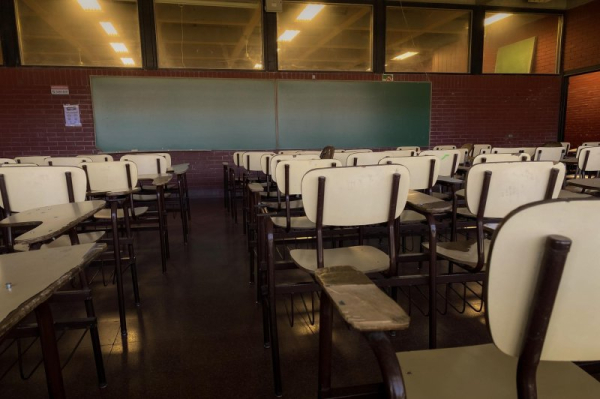
As the United States marks the 250th anniversary of its Declaration of Independence, a debate has reemerged over the condition of civic education. File Photo by Pablo Barrera/EPA
As the United States marks the 250th anniversary of its Declaration of Independence, a debate has reemerged over the condition of civic education.
One useful contribution comes from Jacob Wolf, director of the Program in American Civilization at the University of Austin and a 2022 recipient of the Jack Miller Center’s award for excellence in civic education. Wolf has written that the Declaration “does not demand sentimental reverence or emotional approval, but judgment and moral commitment.”
That concern is not limited to the United States. It speaks to Latin America, where constitutional democracy remains fragile in many countries and where schools often teach the mechanics of institutions without the moral habits needed to sustain them.
Wolf’s observation points to the deeper purpose of civic education. Its aim is not patriotic ceremony or uncritical admiration of national myths. It is to help students understand the principles of free government and the responsibilities of citizenship.
That is the central question facing civic education today: Can democratic institutions survive if they are taught only as procedures, without reference to the values that give them meaning?
A constitutional mandate
Latin America’s constitutions generally recognize civic formation, though in different terms. Mexico’s Article 3 ties public education to values as well as knowledge.
Argentina’s Constitution, in Article 75, charges Congress with education laws that promote “democratic values.” Chile’s Article 19, No. 10 frames the right to education as encompassing more than the transmission of information.
Peru’s Article 14 makes “ethical and civic formation” and instruction in the Constitution and human rights compulsory “in all civil or military education.” Ecuador’s Article 27 centers education on the human person and grounds it in respect for human rights and democracy.
Colombia’s Constitution is especially explicit. Article 41 states that in all educational institutions, public or private, “the study of the Constitution and civic instruction shall be compulsory.” It also calls for democratic practices that allow students to learn “the principles and values of citizen participation.”
In Uruguay, Article 71 establishes that “all educational institutions shall pay special attention to the formation of the moral and civic character of students,” a language with particular resonance for this Uruguayan author.
These commitments reflect a specific history. Much of the region has lived through military dictatorship, internal conflict or deep ideological division. Civic education was not meant to be a decorative addition to schooling. It was meant to help rebuild public life.
The distance between constitutional aspiration and classroom reality remains wide.
The missing moral dimension
Contemporary civic education often avoids discussion of the moral and religious sources that influenced the development of republican life in the region.
This does not require religious instruction in public schools or state endorsement of any confession. Pluralistic societies protect freedom of conscience, and respect for pluralism need not mean historical omission.
Many of Latin America’s founding figures and civic reformers drew on religious conviction and natural-law thinking about human dignity. Those sources helped form ideas of service, sacrifice and limits on power. Acknowledging that history is different from imposing belief, it simply recognizes that the region’s republics did not emerge from moral emptiness.
When these sources are omitted, civic education narrows. Students can learn the language of rights without understanding the responsibilities that sustain them. They can study democratic procedures without developing respect for truth, law and the dignity of others.
That gap is especially consequential where institutions are weak and public trust is low.
Democracy and republican virtue
Latin American political culture has often emphasized democracy more than republicanism. It has also tended to stress the demand for rights more than the fulfillment of duties.
Democracy and rights are essential. But when separated from republican virtue, they become incomplete. A functioning republic depends on citizens who can disagree without dehumanizing opponents and who understand public office as service rather than possession.
Those habits are not produced automatically by economic growth or elections; they depend on deliberate cultivation. A fuller understanding of citizenship treats rights and duties as two sides of the same coin and pairs democratic participation with the moral limits that prevent majority rule from becoming abuse.
Ideological capture, from any direction
A further challenge is the ideological capture of civic education itself. In Venezuela and Nicaragua, state-aligned civic instruction has often blurred the line between democratic institutions and loyalty to the ruling party. Elsewhere, civic education has sometimes drifted toward nationalism or unquestioning obedience to authority.
Neither approach serves the discipline’s purpose.
Civic education, properly taught, does not ask students to repeat slogans, whether revolutionary or patriotic. It forms citizens capable of moral judgment and historical understanding. That means teaching injustice and authoritarianism honestly, while also teaching constitutional limits on power and the rule of law.
The classroom is not a battlefield for ideological recruitment. It is where young people learn how to inherit, criticize and improve their republics.
A generational stake
Across the region, surveys such as Latinobarómetro have repeatedly shown low or declining confidence in democracy, especially as citizens associate it with corruption and insecurity. For many young people, failed leadership deepens that frustration.
The frustration is understandable. But civic education that fails to distinguish between the failures of political actors and the principles of democratic republicanism leaves authoritarian alternatives looking more attractive by comparison.
Civic education that is historically honest and respectful of pluralism neither erases the region’s religious and ethical roots nor imposes belief on students who do not share them.
Its task is not to preserve the past unchanged. It is to prepare citizens who can renew their republics without abandoning the moral foundations that made them possible.
Nibia Pizzo is a Uruguayan psychologist with a master’s degree in management and development of social impact programs from the University of Salamanca. She is director of the Academy of Advanced Studies of Legacy of the Americas, a project of the Global Peace Foundation. The views expressed are solely those of the author.
