


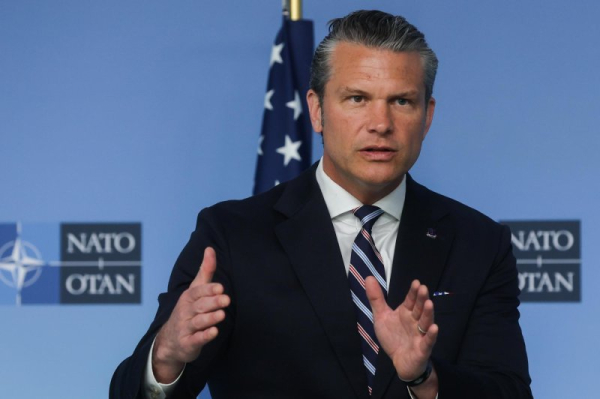
U.S. Secretary of Defense Pete Hegseth has said that using kinetic strikes against alleged narco-terrorists in Latin America are likely to continue for protection of the U.S. homeland, but experts warn that such tactics should be carefully considered. Photo by Olivier Hoslet/EPA
The U.S. strike last week killing Tren de Aragua founder Héctor “Niño” Guerrero Salazar in Venezuela’s Bolívar state, and Secretary of War Pete Hegseth’s subsequent public comments, have focused regional attention on U.S. lethal force as a tool against designated terrorist organizations.
Such strikes superficially resemble tactics used against key figures in extremist groups during the post-September 11 global war on terror — in style and in their reliance on at least nominal host-government concurrence.
Then as now, in the name of Americans killed by the threat a group represented, strikes were framed as an expedient alternative to judicial engagement, too often unworkable in practice.
If that approach proved problematic in the GWOT context, the strategic pitfalls of applying it against narco-terrorist organizations today are greater and deserve serious consideration by U.S. policymakers.
The focus of this article is not the legality and morality of such operations but rather how the United States can pursue its security objectives most effectively in a complex environment.
In managing the threats of narco-terrorism and the unauthorized flows of people, money, and materiel into the United States, as well as extra-hemispheric adversaries operating in the region, U.S. national interest is best served by cooperative, institutionally capable neighbors resistant to both state and non-state threats operating from their territory: partners who engage willingly and creatively out of perceived self-interest, not merely out of fear or obligation.
Lethal kinetic strikes, while tactically effective and sometimes necessary, increase the risk of adverse consequences in five areas: adversary adaptation that reduces U.S. visibility or effectiveness; fragmentation and violence that degrades partner-government capability; heightened mistrust that diminishes future cooperation; political change toward less cooperative governments more open to U.S. adversaries; and erosion of U.S. goodwill and strategic position in the broader global competition.
Where policymakers determine that the imperative for action outweighs these risks, the consequences should at minimum be anticipated and mitigated where possible.
Adversary adaptation
Lethal strikes carry an intended deterrent effect beyond simply eliminating a leader, financier, or technical asset.
As narco-traffickers demonstrated in response to U.S. lethal operations in the Caribbean, shifting from fast boats to commercial cargo containers and more southerly routes, such actions can drive adversaries toward behaviors that are less observable and less vulnerable to interdiction.
Where partner capability or U.S.-partner coordination is imperfect, a strike may degrade a partner’s knowledge of the network more than it degrades the network itself.
Fragmentation and violence
Historically, decapitation strikes have accelerated fragmentation within adversary networks, often accompanied by increased violence as less-seasoned subordinates and competing organizations struggle for control under conditions of uncertainty.
This pattern has recurred repeatedly with the elimination of leadership across major cartel organizations.
The consequences of leadership strikes or arrests against the Sinaloa, Gulf, and Zeta cartels in Mexico, and more recently the CJNG, are instructive. So too are the dismantling of the Mendoza and Lorenzana crime families in Guatemala, and the Cachiros and Valle Valle networks in Honduras.
Partner trust
When U.S. actions are taken without partner consent, or with consent that is effectively coerced, the trust essential to effective cooperation erodes.
As occurred with Dutch and British counterparts following U.S. lethal strikes in the Caribbean, partners may curtail intelligence sharing on legal, political, or other principled grounds, reducing overall effectiveness well beyond the immediate operational context.
Political blowback
Even when U.S. actions are taken with genuine host-nation consent and in support of shared security objectives, they can feed opposition narratives of sovereignty violation. That political damage is magnified by collateral damage or targeting errors.
The Sheinbaum government’s sustained refusal to permit U.S. strikes on Mexican soil, and the Arévalo government’s swift denial that such strikes were being contemplated in Guatemala, illustrate the depth of those sensitivities.
While political fallout can be managed through effective communication and tangible demonstration of shared benefit, excessive strikes causing disproportionate collateral damage, combined with a U.S. posture perceived as disrespectful of sovereignty, risk producing the political ouster of a compliant partner and its replacement by a government actively hostile to Washington.
Such a government may expand, rather than constrain, narco-terrorist access to its territory, curtail security cooperation, and deepen ties with U.S. adversaries, generating strategic harm that far outweighs any tactical gain from the original strike.
Strategic positioning
No single U.S. action is likely to tip the scales, but a sustained pattern of perceived unilateral conduct erodes U.S. goodwill in Latin America and beyond.
China is already exploiting perceptions of U.S. coercion in its public statements and diplomatic engagements, building consensus around alternative governance structures that advantage Beijing and undermine Washington. These include the Global Development Initiative, the Global Security Initiative, the Global Civilization Initiative, and the Global Governance Initiative.
Soft power rarely overcomes a military capability gap or a superior commercial offer, but it often shapes partner decisions at the margins, in precisely the cases where China’s material offer is competitive.
The United States cedes such advantages at its own strategic peril.
In its commitment to putting America first and responding to genuine security threats, Washington sometimes underestimates the strategic consequences that can result from the application of its considerable military, technical, and intelligence capabilities.
The five risks outlined here are not arguments against action — they are arguments for fully accounting for the consequences before committing. When the use of force is necessary, thoughtful planning and messaging, combined with respectful consultation with partners, can substantially reduce the associated risks.
That kind of prudence is not weakness, nor is it naivety. It is the strategic wisdom required to manage the nation’s affairs in an environment where every action carries consequences well beyond the immediate target.
R. Evan Ellis is a senior non-resident associate at the Center for Strategic and International Studies. His latest book, China Engages Latin America: Distorting Development and Democracy, is published by Palgrave Macmillan. The views expressed are solely those of the author.
