


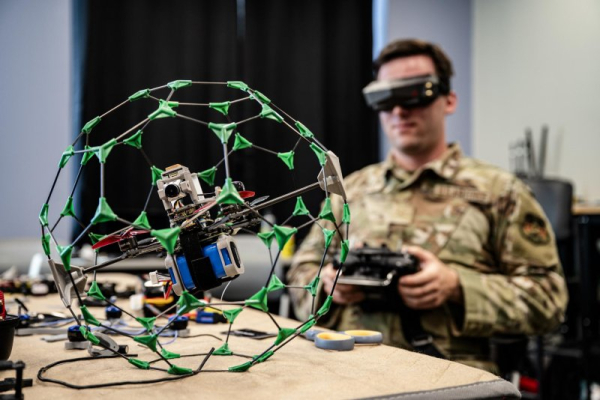
U.S. Air Force Braden Schwartz, a 9th Air Force (Air Forces Central) Battle Lab software engineer, fires up drone operating equipment in November at Shaw Air Force Base, South Carolina. Photo by Tech. Sgt. Aaron J. Jenne.U.S. Air Force
For readers of a certain age, the cry of “Hi Ho, Silver, Away” followed by the William Tell overture will be instantly familiar.
This was the storied Lone Ranger, the masked hero aboard his white stallion, Silver, with silver-tipped bullets in his gun belt. And riding alongside was his ubiquitous sidekick, Tonto, on his mount, Paint, appearing weekly on the tiny TV screens of the 1950’s.
The image is particularly appropriate today, as the Lone Ranger is, in a sense, becoming the Drone Ranger. The question is whether the Drone Ranger needs a sidekick. That answer is not clear and framed by other questions.
Are drones as truly transformational as the stirrup, longbow, gun powder, machine guns and artillery, aviation, submarines and nuclear power and weapons were to war?
Some believe that based on the fighting in Ukraine, where all forms of drones account for the great majority of casualties, the answer is yes. Indeed, the fact that the Houthis in Yemen, not exactly the world’s most advanced society, can threaten the Red Sea with drones and missiles reinforces this view.
But are drones that transformational? Could they become fully independent of all human control and thus achieve complete autonomy of action? Or, like Tonto, will drones by necessity become companions to “Kemosabe,” the manned Drone Ranger? The argument was well put by two experts.
Writing in last month’s Foreign Affairs, retired Army Gen. David Petraeus made the powerful case and prediction that future military leaders would have to be adept in defining the tactical, operational and strategic parameters for the use of all forms of drones, and thus become skilled in writing and understanding AI software to accomplish those tasks.
On the other hand, retired Air Force Lt. Gen. John “Jack” Shanahan, who led the Pentagon’s Artificial Intelligence Office, argued that AI was unlikely to enable full autonomy under virtually all future scenarios and circumstances.
A third argument came from former U.K. Chief of Defense, retired Army General Sir Nick Carter in a creative War on the Rocks digital article. Sir Nick called for understanding and identifying the strategic context and boundaries for drones as the crucial first step in determining where, how and when they could be applied — and, as importantly, where, how and when drones might not be used or that their use was exaggerated.
This week’s annual Sea, Air and Space conference, hosted by the Navy League and held at the National Harbor complex adjacent to the nation’s Capitol, brings these issues front and center.
Many of the exhibits presented leading-edge drone technologies with models of unmanned vehicles that in real life would be 150 to 200 feet long and reportedly capable of traveling thousands of miles at high speeds, completely untethered to human control-Drone Rangers without Tonto.
The U.S. Navy has requested proposals for medium-sized unmanned surface vessels that are due this week so decisions can be made on which future fleet composition might be based.
The argument made by the new chief of Naval Operations, Adm. Daryl Caudle, and his staff is that drones can exploit this potentially transformational nature of conflict and offset the huge costs of modern warships. The price tag for a new battleship could be as high as $22 billion.
But while submarines date to the Civil War and the first real airplanes to 1903, it took time to determine the utility and strategic value of each. The same time factor may not apply to drones. The technology is changing so quickly that in the case of the Wright brothers, their biplane might have become jet-propelled in months and not decades.
What is needed, as Gen. Carter noted, is a framework for determining the ultimate strategic utility of air, surface and subsurface unmanned vehicles, and not just tactical or operational advantages.
From that context, you can then define the essentials: command‑and‑control; self‑defense and protection for surface drones; maintenance and repair while underway; rules of engagement for when to deploy them; basing and housing potentially thousands of drones across all types; and the long‑term costs and support requirements that are often overlooked.
Whether we will hear “Hi Ho, Silver” and the masked man and Tonto riding off together in the future remains to be seen. But do not discount this metaphor when thinking about drones.
