


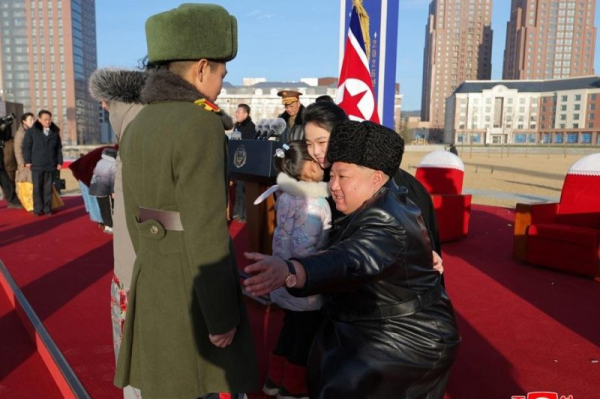
North Korean leader Kim Jong Un (R) and his daughter, Kim Ju-ae (2-R), greet bereaved family members during the opening ceremony of Saeppyol Street, a new housing district dedicated to the families of fallen soldiers in the Hawasong area of Pyongyang, North Korea, in February. Kim inaugurated the housing district in Pyongyang for families of troops who died in overseas military operations. File Photo by Korean Central News Agency/EPA
On the Russian-Ukrainian battlefield, the moment a North Korean soldier finds himself surrounded, his hand does not reach for his rifle — it reaches for a grenade pin.
The world’s media calls this fanaticism. I see it differently. I was trained the same way. I recited the same oaths. I sang the same songs.
In North Korea, I served in the Korean People’s Army for more than three years. I am not writing this to condemn the dead. I am writing to explain why they made that choice — and how that choice was engineered to feel like the only natural one — through the internal logic of the world I once lived inside.
Logic planted before birth
A North Korean soldier does not first encounter the concept of “dying for the Supreme Leader” when he enlists. It begins in kindergarten. Children learn the song, “We will defend General Kim Jong-un with our lives” before they learn to read the Korean alphabet.
The first page of every elementary school textbook bears the portrait of Kim Il-sung, Kim Jong-il, and Kim Jong Un, and children are conditioned to love those faces as they would a father. Suryong Gyeolsa Ongwi — pledging one’s life to defend the Supreme Leader — is not a slogan. In North Korea, it is the foundational grammar of a person’s identity.
This may look like brainwashing from the outside. But for a person who has lived within it for 20 years or more, it is not a “belief. It is simply reality. Just as we do not question gravity, a North Korean soldier does not question self-sacrifice for the leader. It is as natural as breathing.
In that surrounded moment, what operates inside the soldier’s mind is not fanaticism. It is 20 years of accumulated reality — the knowledge that surrender means his family dies.
System takes families hostage
The most powerful force driving a soldier toward self-destruction on the front line is not ideology. It is the system of collective punishment known as yeonjwaje (guilt-by-association).
In North Korea, if a soldier becomes a prisoner of war, the consequences extend far beyond that individual. His parents, siblings and spouse left behind at home are immediately reclassified as “the family of a traitor.” Deportation to a political prison camp or a remote coal mine awaits them. The “betrayal” of a single person rewrites the fate of an entire family.
The testimonies of North Korean soldiers captured by Ukrainian forces confirm this. Even as one soldier slipped toward unconsciousness from blood loss, bound and restrained, he threw himself headfirst into a wall in a desperate attempt to die.
That is not madness. That is a cold calculation: If I survive and am captured, my family is destroyed. If I die, my family survives — perhaps even honored as the family of a hero. Reports that Kim Jong Un has arranged for fallen soldiers’ families to reside in Pyongyang and for their children to be admitted to elite revolutionary schools complete that calculation perfectly.
Reality with no outside world
Almost all North Korean defectors, before they escape, have no idea how ordinary people live beyond the country’s borders. The world beyond our map was darkness. The soldiers deployed to the Ukrainian front were operating under extreme information deprivation.
What it would mean to be taken prisoner by Ukrainian forces — the Geneva Conventions, the treatment of POWs, the possibility of a life afterward — existed for them as a complete unknown. What happens when one surrenders, on the other hand, they knew with bone-deep certainty: the collective punishment system would be activated against everyone they loved.
What you do not know, you fear. What you fear, you avoid. Human beings dread an uncertain future more than a certain terror. For a North Korean soldier, the certainty of death is less frightening than the uncertainty of surviving in a world he cannot imagine.
Language that glorifies death
The narration accompanying the footage broadcast on Korean Central TV called self-detonation “the heroic sacrifice of warriors in the heat of battle.” Kim Jong Un published a letter of condolence written in his own hand. A Wall of Remembrance went up in Pyongyang. A national memorial was built. Senior Russian officials visited Pyongyang to lay flowers.
Whatever the political calculation behind all of this — whether it is designed to extract greater compensation from Russia or to reframe as glory what was once kept secret — the message it sends to surviving soldiers is singular: Those who self-destruct become heroes. Their families are rewarded. Those who are captured become traitors. Their families disappear.
The moment a state pins a medal on death, death becomes a legitimate option. And surviving — choosing to live — becomes an act that requires courage.
Self that was hollowed out
In the North Korean military, the individual does not exist. There is no “I” — only “our Supreme Leader,” “our Party,” “our Homeland.” The instinct for personal survival is conditioned to feel shameful in the face of collective honor.
When a fellow soldier has cleared the path by detonating himself, raising your hands in surrender — within the inner architecture of a North Korean soldier’s identity — is an act of self-annihilation. It is a shame more unbearable than death.
It was in China, encountering the outside world for the first time, that I began to sense something was wrong, though I only realized much later that I had been trusting North Korea’s propaganda and indoctrination more than what my own eyes were showing me.
Coming to understand that fully took years. The soldiers on the front line have no time, no information and no experience that would allow them to reach that understanding.
What it means to understand them
I did not write this essay to praise these soldiers. I am not saying their deaths were right. I want to help the world understand them as accurately as possible — because without understanding, the structure that produces this cannot be changed.
While Kim Jong-un packages self-destruction as a national honor, the soldiers who survived and were taken prisoner are almost certainly still living in terror over their own choices.
International human rights organizations are right to condemn this as a violation of international humanitarian law. But that condemnation does not reach North Korean soldiers. The language simply does not exist in the world they inhabit.
To stop the hand that pulls the pin, we must first understand why that hand learned the motion so naturally. I am one of the people who knows. That is why I wrote this. And that is why I will not stop.
Hyunseung Lee is a North Korean escapee, lead strategist at the Global Peace Foundation, founder of the North Korean Young Leaders Assembly and a regular contributor to the Korea Regional Review. He has experience in North Korea’s shipping and mining sectors and as a sergeant in the DPRK Army Special Force. He fled in 2014 due to severe governmental purges. He holds a bachelor’s degree in economics from Dongbei University of Finance and Economics and a master’s degree in public administration from Columbia University.
