

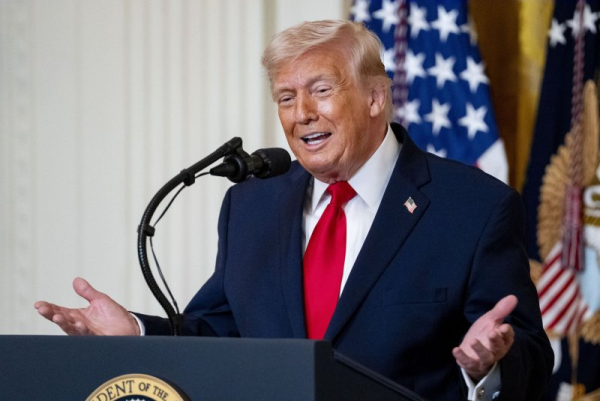
The Shield of the Americas summit in Doral, Florida, on March 7, put hemispheric security back at the center of regional politics. President Donald Trump used the gathering to call for stronger action against cartels and other criminal groups in the Western Hemisphere, while the U.S. government paired the event with a proclamation framing the effort as part of a broader push for regional security cooperation. Photo by Bonnie Cash/UPI | License Photo
The Shield of the Americas summit in Doral, Florida, on March 7, put hemispheric security back at the center of regional politics. President Donald Trump used the gathering to call for stronger action against cartels and other criminal groups in the Western Hemisphere, while the U.S. government paired the event with a proclamation framing the effort as part of a broader push for regional security cooperation.
At one level, the message was straightforward: Washington wants closer cooperation against organized crime and transnational threats. Trump’s proclamation said criminal cartels and foreign terrorist organizations in the Western Hemisphere should be demolished to the fullest extent possible, consistent with applicable law, and it referred to the Americas Counter Cartel Coalition as a pledge from military leaders and representatives from 17 countries.
That alone makes the effort noteworthy. But the larger significance of the Shield of the Americas lies not only in its rhetoric of urgency, but also in the kind of hemispheric framework it may become.
Why the effort matters
Across the Americas, criminal networks now move people, drugs, money and weapons across borders more easily than many governments can coordinate against them. In several countries, organized crime is no longer just a policing issue. It has become a challenge to sovereignty, institutions and public confidence.
So the basic logic of the Shield is clear. A regional threat needs more than isolated national responses. Stronger cooperation makes sense. Just as important, this framework is not being presented as a supranational authority or a classic multilateral treaty. Its official framing points to something more flexible: a political platform for coordination among sovereign governments acting through their own laws, institutions and procedures.
That distinction matters. It suggests that participating states are not being asked to surrender legal authority, but to align efforts against threats that cross borders faster than traditional diplomacy often can.
This may prove to be one of its most practical features. Governments often need channels for coordination that are faster and more targeted than creating a new international body. The Shield appears designed to answer that need.
More than a summit photo
The project also appears designed to go beyond symbolic declarations. Its public presentation emphasized political dialogue, coordination, joint action and follow-up. That does not mean a unified command structure is emerging. It does mean the participating governments are signaling that they want this framework to function beyond a one-day event.
That point matters because one of the chronic weaknesses of hemispheric diplomacy has been the distance between speeches and implementation. A summit can produce headlines, but it rarely changes realities on the ground unless there is some mechanism for continuity. In this case, the U.S. side has indicated there will be a follow-up dimension, including a special envoy for the effort. If that role is used seriously, it could help sustain coordination rather than letting the project fade after launch.
A coalition with visible strengths and key absences
The summit was not insignificant in terms of representation. Governments from countries including Argentina, Costa Rica, Ecuador, El Salvador, Guyana, Honduras, Panama, Paraguay, the Dominican Republic and Trinidad and Tobago were among those publicly associated with the effort, alongside the United States. That gives the Shield visible regional backing and shows that the demand for stronger security cooperation is not confined to Washington alone.
But the summit also raised a second question: Who exactly is this coalition meant to represent?
Public reporting on the Doral meeting noted that several important countries were absent, including Mexico, Brazil, Colombia and Guatemala, underscoring the limits of any claim that the new framework already represents the hemisphere as a whole. Their absence does not negate the value of the effort, but it does show that the Shield is not yet a fully hemispheric architecture.
That means its credibility will depend on what comes next. If the Shield of the Americas remains mainly a politically aligned grouping, it may generate headlines but fail to create a durable framework. If it evolves into a broader, rules-based mechanism with wider legitimacy, it could become more significant over time.
Force alone is not enough
There is another limit as well. Trump urged Latin American leaders to use military action against cartels, and the U.S. proclamation emphasized hard power. In some countries, that argument will resonate, especially where criminal organizations are heavily armed and state institutions are under severe pressure.
But force alone is not a full strategy. Real progress also depends on intelligence sharing, financial enforcement, judicial coordination, prison reform, anti-corruption measures and stronger institutions. Criminal networks survive not only because they are violent, but because they exploit weak governance and fragmented state responses.
It is also important to note what the Shield is not. It has not been described as a military alliance, a standing force or a structure of unified command. Its public presentation points instead to a political and diplomatic framework for cooperation. That makes it potentially more flexible, but it also means success will depend heavily on the seriousness of national implementation.
What will determine its future
For Latin American governments, the challenge is to help shape any new security framework rather than simply receive it. Regional cooperation is necessary, but so are clear legal boundaries, shared ownership and respect for sovereignty. If this framework is to mature, governments in the region will need to insist that it remain both effective and institutionally credible.
The Shield of the Americas may prove to be an important step. It may also turn out to be a politically striking but limited experiment. The difference will depend on whether it can move beyond symbolism and produce practical results.
More broadly, the Shield may reflect a contemporary model of cooperation among states: one built not on the creation of a new formal organization, but on joint declarations and sustained coordination around specific security goals. In a hemisphere facing increasingly transnational threats, that approach may become more common.
The region clearly needs more serious cooperation against organized crime. The real debate is not over whether cooperation is needed, but over how it should be structured, who should shape it and whether it can endure beyond one political moment. That is the bigger question the Shield of the Americas has now placed before the hemisphere.
Óscar Álvarez Araya is a political scientist and former Costa Rican ambassador to Taiwan. The views and opinions expressed in this commentary are solely those of the author.
