
How Korean identity exists beyond state borders.


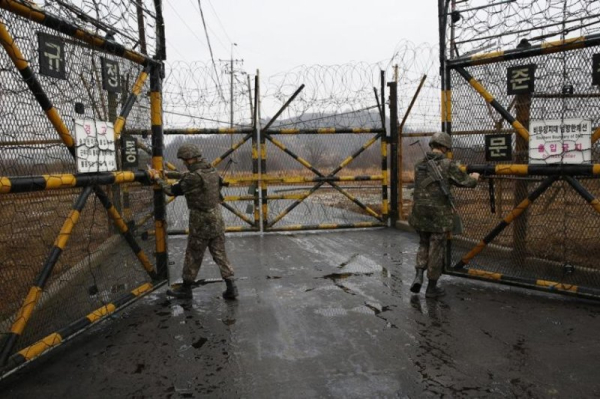
South Korean soldiers open the gate of the Demilitarized Zone, a site of fierce battles in the 1950-53 Korean War, in the central section of the inter-Korean border in Cheorwon, Gangwon Province, South Korea, in December 2018. File Photo by Jeon Heon-kyun/EPA
“What’s your background?”
When faced with such a loaded question, often filled with political implications that signaled national allegiances, the answer that every person from South Korea, North Korea or the diaspora gives is the same: “I’m Korean.”
The weight attached to this common answer isn’t political, but historical. Throughout the history of Korea, its people survived countless invasions by forming a united front. In even simpler terms, Koreans became defined by a collective moral compass that served as a spiritual guide whenever state structures failed to protect them.
Hongik Ingan, which means “to broadly benefit all humanity,” is a moral principle that strives to improve the social welfare of the world rather than the individual. Koreans, no matter their origin, live with a deep, historic grief that can be rectified by supporting one another through turmoil.
Not only did this serve as the spiritual origin for Korean identity, but it functioned as an ethical framework that overrode the temptation of retaliation during times of hardships.
The kingdom of Gojoseon was a safe haven for Koreans to share this likeminded ideal. Ancient Koreans were deeply connected to the world and each other, forming a unique sense of unity that empowered Gojoseon to become one of the greatest political entities in the region.
But, the kingdom fell in 107 B.C. after Emperor Mu of the Han dynasty captured its lands to consolidate the dynasty’s position, forcing Gojoseon migrants to flee southward to the Jin state.
Instead of Gojoseon fading out of existence, their legacy survived through its descendants’ resolve to keep their memory alive. Under a shared belief in Hongik Ingan, northerners blended new culture and technology with indigenous practices in the south. The remnants of Gojoseon represent the first instance of Koreans uniting under a common ideal in response to persecution.
More than 2,000 years later, this same tactic was repurposed to combat Japanese assimilation policies during the colonial era. Rather than perpetuate the cycle of violence, Koreans used the spirit of Hongik Ingan to strive for a virtuous path that benefited all parties.
The Declaration of Independence for Korea in 1919 stressed that reinstating their sovereignty allowed Koreans to lead fulfilling lives on their own, which guides Japan away from its evil path and frees China from its paranoia. In turn, this would unite the East and spread peace and happiness across mankind.
Twentieth-century Koreans did not consider the present hardships when composing their plea for independence, but looked to the future, understanding that holding onto their hatred neither benefited themselves nor the rest of the world. Instead, Korean activists set aside their resentment from colonization to act as a mentor for Japan. Although Hongik Ingan’s intention was to incite hope, it also destabilizes the power behind oppression.
However, this long stead practice on the peninsula faded into obscurity through modernized socioeconomic norms, where individual success is prioritized over community building. While many would argue that North Korea is the only country that benefits from unification, South Korea also needs its northern counterpart to advance.
Against the odds, South Korea grew out of their repressed, impoverished roots to transform into a global powerhouse, integrating liberty with central authority. Unfortunately, its wealth is not an indicator of sustainable success, as South Koreans are unable to progress, resulting in rampant socioeconomic inequality. As long as Korea remains separated, its incomplete institutions cannot support the mental well-being of their people.
Unification naturally heals the social unrest that plagues Koreans, as it fixes the fundamental cause behind generational trauma: a lack of unity during times of injustice. Their people are not characterized by statehood or pure ethnic homogeny, but through the ideology of nurturing the tragic historic connections between humans to advance world peace.
Once Koreans understand the similarities in their common past, they can build on each other’s differences and look forward.
South Koreans must take moral responsibility as a country gifted with a democratic upbringing to teach northerners about their unquestionable human rights. Simultaneously, North Koreans must pull southerners out of their social isolation by participating in genuine dialogue.
Both sides of the border can heal the hurt cast upon one another if they approach the future with forgiveness, bonding on a spiritual principle only they would instinctively understand.
When faced with the destruction of their homes, the refugees of Gojoseon and the Koreans under Japanese rule accepted and reciprocated goodwill to the people around them to eradicate archaic wounds.
There is no state or government that defines Korean heritage. Rather, it is shaped by an innate understanding of human connections. For unification to become successful, all Koreans need to rely on each other.
Kayleen Tran is a human‑rights researcher whose work with the Committee for Human Rights in North Korea focuses on documenting abuses and elevating the voices of affected communities. Her analyses blend policy insight with a commitment to exposing conditions that often remain hidden from the global public. She approaches each project with a careful balance of rigor and empathy, ensuring that the human impact of systemic oppression is never lost in the data. Her writing challenges readers to confront uncomfortable realities and consider their role in advancing accountability. Through her work, Tran continues to push for greater transparency, justice and international engagement on human‑rights issues.
