

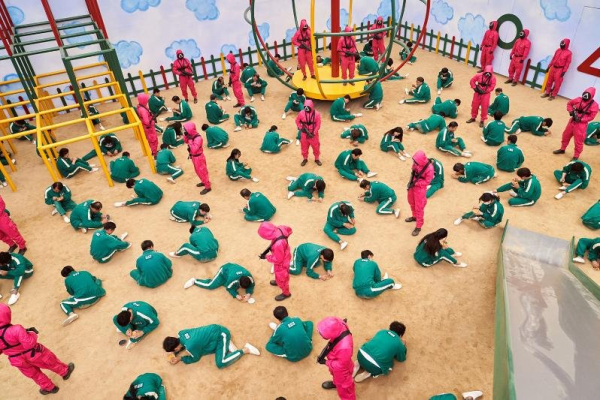
The North Korean teenagers were not executed for watching Squid Game. They were executed because they glimpsed the possibility of choice, and comparison began. Photo courtesy of Netflix
The author prefers to use the lowercase “n” to challenge the Kim family regime’s legitimacy.
Amnesty International recently released a report revealing that in north Korea , teenagers were executed for watching the South Korean drama, Squid Game. The shock of this event lies not only in the cruelty of the punishment. The fact that a single TV series could be met with execution clearly shows what this regime fears the most.
Did the drama really threaten national security?
Or was it the “possibility of a different life” that posed the real threat?
Dictatorship always fears information more than guns. During the Cold War, it was not military coups, but information that brought down Eastern European communist regimes.
Western radio broadcasts, smuggled videotapes, music and culture did not incite revolutions. They simply made comparison possible. And comparison breeds the question: “Why must we live like this?”
Information does not attack the regime directly. Instead, it erodes the myths that the regime depends on to maintain itself. Leaders become human rather than divine, and obedience becomes coercion rather than virtue.
This is why the Kim Jong Un regime obsessively blocks external information. What it fears is not K-pop or South Korean dramas, it is the cracks in perception that comparison creates.
The information blockade in north Korea is not mere censorship. It is a political project to maintain a language system, a worldview and a framework of authority.
For more than 70 years, north Korea has used the concepts of “imperialism” and “colonialism” as doctrinal tools to justify its rule. Every failure is blamed on external imperialism, and every act of oppression is legitimized as resistance.
The problem is that this language no longer remains confined to north Korea. China repeats the same rhetoric, and unfortunately, elements of South Korean and Western society are increasingly absorbing this language naturally.
Critiques of imperialism have become faith rather than analysis, and capitalism is treated not as an economic system, but as an ideology morally condemned in advance.
Kristin Niemietz’s book, Imperial Measurement, precisely highlights this point. It criticizes modern discourse that reduces capitalism from an empirical, historical object of study into a moral doctrine of “intrinsically evil systems.” Measurement and comparison disappear, leaving only moral binaries. As a result, capitalism is no longer something to be tested or understood – it is a belief system already condemned.
This structure closely resembles north Korea’s propaganda logic. In north Korea, capitalism is not an economic system but an absolute evil that corrupts human beings. Citizens are trained to hate capitalism without understanding it. They cannot compare, they cannot choose. Socialists understand that the moment capitalism becomes an “ideology,” independent thought stops.
This is why information is dangerous. Information does not promote capitalism; it makes comparison possible. It allows people to recognize that other lives exist, that other choices are possible. And that recognition turns individuals from objects of the regime into independent subjects.
The problem with socialism is that it cannot tolerate this subjectivity. Inequalities under capitalism are deemed intrinsic evils, yet human rights abuses under socialist states are always treated as exceptions. Nothing to Envy becomes a formula that absolves responsibility.
In reality, this ideology is the opposite of the truth. north Korea is a hereditary caste society where human value is assigned by bloodline. China, despite claiming socialism, detains Uyghurs en masse and systematically erases their religion and culture. This is not a product of capitalism — it is violence justified in the name of socialism.
Yet, such realities are rarely addressed in contemporary discourses on imperialism and race. Instead, declarations like “the West is inherently guilty” and “only socialism is the solution” are endlessly repeated, leaving human rights abuses in East Asia largely invisible.
The north Korean teenagers were not executed for watching Squid Game. They were executed because they glimpsed the possibility of choice, and comparison began. And comparison threatens not only dictatorship, but also the moral supremacy monopolized by certain ideologies.
Information frees humans. That is why every dictatorships must control information, and every ideology selectively filters it. The moment capitalism is treated as an ideology and socialism as moral authority, comparison is prohibited and questioning becomes dangerous.
Silence in the face of information suppression is not justice. The true dividing line is not ideology — it is information. Who can see what, who can compare and what questions can be asked?
The executions in north Korea were not a punishment for watching a drama. They were a punishment for the very possibility that humans could perceive, reflect and judge for themselves. And that possibility always begins with information.
Jihyun Park, a British Korean Conservative politician and regular contributor to the Korea Regional Review, is a north Korean escapee who fled twice from the country — in 1998, which resulted in a forced repatriation, and in 2008, which was successful.
