

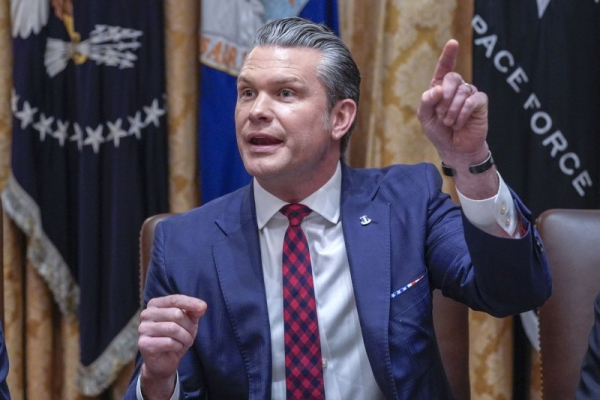
Secretary of Defense Pete Hegseth denies giving the order to kill two survivors of an earlier U.S. attack on an alleged drug boat in the Caribbean. Photo by Yuri Gripas/UPI | License Photo
Last month, six Democratic members of Congress made a video tape reminding men and women in uniform that it was their duty to disobey readily apparent illegal orders.
A firestorm was ignited inside the administration and with its allies. The Pentagon threatened to investigate and, if necessary, recall to active duty former naval aviator and astronaut Sen. Mark Kelly of Arizona to punish him for his role in that video.
Never before in my experience have service personnel been told by members of Congress that it was their duty under the Uniform Code of Military Justice to disobey an illegal order. But the elected officials believed they had good reason.
The cause célèbre was the administration’s orders to a naval fleet in the Caribbean to intercept and destroy high-speed small boats suspected of transporting drugs.
The Posse Comitatus Act of 1868 explicitly forbids the United States from employing the military in law enforcement roles. But the administration has declared Venezuelan drug cartels terrorist organizations and claims the authority to attack them as it has attacked al Qaeda and other extremist terrorist groups.
But no legal precedent exists to justify these actions.
Last week, the questions about the legality of Operation Southern Spear took on greater relevance. Several media outlets reported that two unarmed and helpless survivors of the first attack were ordered killed. The incident increases to generate congressional concern.
It is unclear who gave the order to Vice Adm. Frank Bradley, commander of Special Forces Command, who is in charge the Caribbean operation. Bradley, a SEAL, is highly experienced, and in my interviews with those for whom he worked, he is very knowledgeable about the rules of war.
Secretary of Defense Pete Hegseth denied giving the order. That is under investigation. Admittedly, there can be ambiguity in differing between a legal order and one that is not and can lead to a charge of murder.
In Vietnam, plausible deniability often led to excesses. Operation Phoenix, designed to neutralize local Vietcong cadres, led to tens of thousands of deaths and outright murders of innocent Vietnamese.
Even though the circumstances in this case in the Caribbean seem unambiguous, that is not always the case.
A highly personal example: When I served in Swift Boats in Vietnam, Vietnamese men of a certain age, under certain circumstances, could give the appearance of being Vietcong. Single men in junks were particularly suspicious especially they fled after being told to stop. There were reasons for that, including fear of wrongful detainment.
Warning shots were authorized. If the “evader” refused to stop and continued to flee, the use of deadly force was authorized. On one occasion, we spotted a Vietnamese male adult in a small sampan desperately trying to reach the shore. In the junk was a weapons sized object wrapped in a tarpaulin. It could have been an automatic weapon or an RPG rocket launcher.
Unsure, although the rules would allow firing, I held fire. As this man reached the beach, automatic weapons fire opened up on us from the shore. Any ambiguity was resolved.
Not every situation is that clear. But unlike my experience, the two survivors were helpless and no one was firing on U.S. forces.
If, assuming the administration is correct in its arguments, let us test the proposition that killing designated terrorists is legal without congressional approval.
If Venezuelan drug cartels are designated terrorists, why does the same logic not apply to American cartels plying their evil trade in the United States? If that were the case and a SWAT team raided a local cartel operation, killing all but a few, why not shoot the rest? And how would that play in Congress and among the American public?
There are rules of war and criminal statutes. In the circumstances surrounding the killing of the two survivors of the destroyed drug boat, this was certainly murder. And worse, would it not have been smarter to detain both, question them for possible intelligence, confirm that these boats were carrying drugs and determine their final destination?
The Rules of Engagement for this operation have not been made public. And while Congress is beginning to question these killings and the legal basis for them, far greater oversight is needed.
Declaring the drug cartels as terrorists has no legal precedence. And no matter who gave the order, this still looks like murdering two unarmed survivors.
Further, this is not war. And the excesses of Vietnam are surely unwelcome here. The bottom line: Congress needs to be more closely engaged and for once take the administration to task for breaking the law.
Harlan Ullman is UPI’s Arnaud de Borchgrave Distinguished Columnist, senior adviser at Washington’s Atlantic Council, chairman of a private company and principal author of the doctrine of shock and awe. His next book, co-written with Field Marshal The Lord David Richards, former U.K. chief of defense and due out next year, is Who Thinks Best Wins: Preventing Strategic Catastrophe. The writer can be reached on X @harlankullman.
