

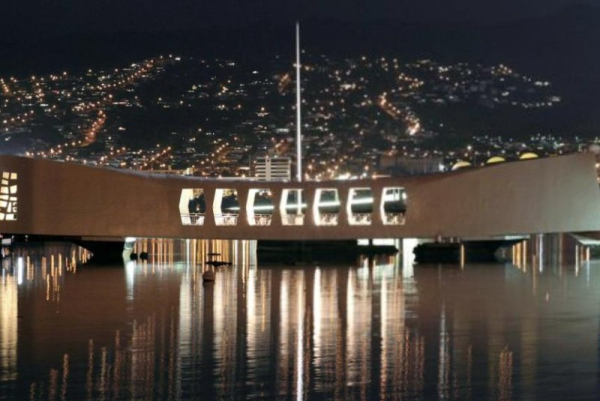
The Pearl Harbor Memorial honors the lives lost in the December 7, 1941, attack on Pearl Harbor. Photo courtesy of National Archives
Taking the Admiral’s barge to visit the watery grave of the Pennsylvania-class battleship USS Arizona is always emotional and moving.
Of the 1,177 Arizona sailors killed that day, about 1,100 and their commander, Rear Adm. Isaac Kidd remain trapped as the ship was sent to the bottom on the morning of Dec. 7 1941, after Japan’s surprise attack. One can only imagine the horror when Arizona’s forward magazine exploded.
Of the eight battleships sunk or damaged that day, all but two returned to service. The Arizona and the USS Oklahoma did not.
But what if Adm. Chuichi Nagumo, who commanded the attack, had the good fortune or cunning to wait until two of Pearl Harbor’s three carriers returned to port? What if USS Lexington and USS Enterprise had been sunk instead of the battleships? (The third carrier, the USS Saratoga, was undergoing a refit on the U.S. West Coast.)
What if Nagumo had attacked Pearl Harbor’s vast fuel farms, destroying the oil that powered the U.S. Navy ships and aviation gasoline for its aircraft? And what if Nagumo had gone after the submarines alongside Naval Station Pearl Harbor?
The United States would not have been able to fight the Battle of the Coral Sea six months later that put a temporary halt to Japan’s march across the Pacific. And while the Lexington would be sunk at that battle, without Enterprise — the Big E — the most decisive naval contest at Midway that changed the course of the war never would have happened.
Fortunately, none of those hypothetical events occurred. Had they, what might have been the course of the war?
Hitler still would have gratuitously declared war on the United States, which finally brought America fighting alongside Britain. Perhaps as the Arsenal of Democracy churned out nearly 100 aircraft carriers of all sizes and some 6,000 warships, the war in the Pacific ultimately would have been won. But there’s another “what if” to consider.
As the attack on Pearl Harbor was a critical inflection point in history, so was Sept 11, 2001, when New York’s Twin Towers came crashing down after two al Qaeda hijacked aircraft flew into those buildings.
President George W. Bush immediately declared a global war on terror. And the hunt was on for the mastermind of that attack, Osama bin Laden. He sought refuge in Taliban-controlled Afghanistan.
After the Taliban refused to turn bin Laden over to the United States, Bush ordered on Oct. 7, 2001, the commencement of Operation Enduring Freedom in Afghanistan. The operation quickly collapsed Taliban rule, largely thanks to Afghanistan’s Northern Alliance that had been financed and trained by U.S. Special Forces and the Central Intelligence Agency. The iconic image of American Special Forces riding horseback calling in B-52 air strikes captured the speed with which the Taliban was defeated.
Unfortunately, in this melee, bin Laden escaped to Tora Bora, the very mountainous terrain with elevations up to 14,000 feet that borders on Pakistan. From Dec. 15 to 17, the Battle of Tora Bora was fought. And Osama escaped.
One reason was poor planning by the United States. But what if Osama had been killed or captured at Tora Bora? Would that have ended the global war on terror? And would the United States and its NATO allies have begun a 20-year occupation of Afghanistan that led to failure as the notion of nation-building turned to dust?
Would the United States have gone into Iraq and the subsequent debacle that drained America and produced chaos and an insurgency, claiming the lives of too many Iraqis and coalition forces?
All these are imponderables. However, the “what if” question is now very relevant today as the United States and Israel are in the third week of the “excursion,” as Donald Trump calls it into Iran.
Suppose that instead of joining Israel in this war, the United States stood aside after Israel launched its decapitation strike that eliminated some 40 of Iran’s senior leaders. Obviously, the United States would not be at war in the Gulf. The Strait of Hormuz would remain open. And the Gulf states would not be on the receiving end of Iran’s missile and drone attacks.
It is too early to know how this war will turn out. But what if Afghanistan and Iraq are precursors? Then this war may not have a satisfactory ending.
Harlan Ullman is senior adviser at Washington’s Atlantic Council, chairman of a private company and principal author of the doctrine of shock and awe. His next book, co-written with Field Marshal The Lord David Richards, former U.K. chief of defense and due out in late 2026, is Who Thinks Best Wins: How Decisive Strategic Thinking Will Prevent Global Chaos. The writer can be reached on X @harlankullman.
