
What the 2026 DNI Threat Assessment tells us about the new age of vulnerability.

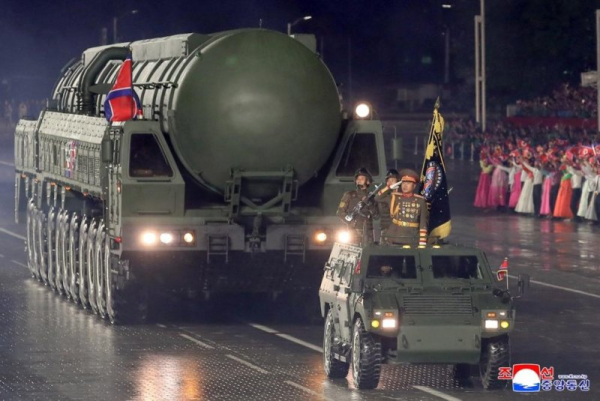
A new intercontinental ballistic missile is displayed during a military parade celebrating the 80th founding anniversary of the Workers’ Party of Korea at the Kim Il Sung Square in Pyongyang in October. Photo by North Korean Central News Agency/EPA
Director of National Intelligence Tulsi Gabbard delivered her annual threat assessment Wednesday and Thursday before the Senate and House Intelligence committees, respectively.
What she presented was not a routine briefing. It was a chilling declaration that the continental United States faces existential threats that have crossed the threshold from theoretical possibility to operational reality.
Speaking on behalf of all 18 U.S. intelligence agencies, Gabbard left no room for ambiguity: The American homeland is no longer a sanctuary.
As someone who has long observed Kim Jong Un’s obsession with building nuclear capabilities — from inside North Korea and beyond — I can say this assessment is fundamentally different from its predecessors.
Past reports spoke of “potential threats.” This one confirms them as real. Just on Saturday, Iran fired ballistic missiles traveling more than 4,000 kilometers at the joint U.S.-U.K. base on Diego Garcia in the Indian Ocean, amplifying the alarm even further.
North Korea stands alongside Iran at the forefront of a global anti-American front, directly challenging the values that America represents.
North Korea’s ICBMs: from estimate to confirmed reality
The most consequential shift in the 2026 assessment was the reclassification of North Korea’s intercontinental ballistic missile capability. What intelligence agencies once described as “probable” or “assessed” has been elevated to confirmed reality. It is no longer a question of “if” but “already.”
The Hwasong-15 (range: 13,000-plus km.) and the Hwasong-17 (range: 15,000-plus km., MIRV-capable) can strike any target across the continental United States. But it is the Hwasong-18 that represents the true paradigm shift.
As a solid-fueled ICBM, it can be launched with virtually no warning. The “golden time” during which U.S. forces might detect and respond to launch preparations has effectively vanished. Washington, New York and Los Angeles all sit within its reach. This is no longer an intelligence estimate. It is an officially confirmed fact.
North Korea’s hypersonic blade: beyond interception
The emergence of North Korea’s hypersonic missiles compounds the threat further. Traveling at speeds that exceed Mach 5 while executing irregular maneuvers at low altitudes, these weapons represent the most difficult challenge facing any existing missile defense system.
In January, claimed its hypersonic missile flew approximately 1,000 kilometers and struck its designated target. Kim Jong Un declared that North Korea must “advance its nuclear war deterrent and continue to develop offensive weapons systems.”
The implication is chilling. Key U.S. military installations in South Korea and Japan could be struck within 10 minutes, with current defense systems unable to intercept. America’s safe zones are vanishing.
The 600mm super-large multiple rocket launcher
North Korea’s 600mm super-large multiple rocket launcher, despite its name, performs as a short-range ballistic missile. With a range of 420 kilometers, precision guidance and the capacity to carry the Hwasan-31 tactical nuclear warhead, it can saturate South Korea’s airfields, military installations and critical infrastructure in a single coordinated salvo.
Dozens to hundreds of launchers can each fire four rounds in rapid succession. This is not a deterrent. It is a first-strike capability.
North Korea is not Iran
At the very moment Gabbard took the witness stand, U.S. forces were conducting Operation Epic Fury against Iran. Launched Feb. 28, the operation devastated Iran’s nuclear enrichment facilities. Yet, Gabbard was explicit in warning against the false comfort this success might invite.
Unlike Iran, North Korea is estimated to already possess approximately 100 completed nuclear weapons. It harbors zero intention of denuclearization and is instead accelerating the expansion of its stockpile at an exponential pace. North Korea completed the bomb long ago — and the proliferation of nuclear missile systems capable of threatening the American homeland is only accelerating.
But one fact remains clear: In North Korea, the man obsessed with nuclear weapons — the sole authority who would press the button — is Kim Jong Un. Remove him and the nuclear threat could end.
Cyber warfare: Your wallet funds their warheads
The most immediately tangible threat, however, may be the one already unfolding in the digital domain. According to a report published in October by the Multilateral Sanctions Monitoring Team — an 11-nation coalition launched under South Korean leadership at the United Nations — North Korea stole $2.8 billion in cryptocurrency in just 21 months, from January 2024 through September 2025.
Separately, blockchain analytics firm Chainalysis estimated that North Korea’s cumulative cryptocurrency theft has reached $6.75 billion. How many more nuclear warheads can that money build? How many more ballistic missiles can it produce? There is a reason U.S. intelligence agencies regard the acceleration of North Korea’s nuclear and missile capabilities with such alarm.
What makes this threat even more dangerous is the evolution of its methods. Where North Korean hackers once scraped together small sums through low-level attacks, they have now shifted to a “Big Game Hunting” strategy — spending months meticulously profiling targets before extracting hundreds of millions of dollars in a single strike. In February 2025, they successfully stole approximately $1.5 billion from the Dubai-based exchange Bybit — the largest single cryptocurrency heist in history.
At this very moment, digital assets stolen from U.S. citizens and corporations are being directly converted into funding for Hwasan-31 nuclear warheads and ICBM mass production. The money hacked from your account today is building the missile aimed at your city tomorrow.
A geopolitical coalition of threat
Gabbard emphasized that North Korea does not operate in isolation. It sits at the center of a geopolitical coalition linking Russia, China, Iran and Pakistan.
Russian transfers of advanced missile and satellite technology have allowed North Korea to achieve decades of progress in a matter of years. The deployment of more than 12,000 North Korean troops and massive shipments of weapons and artillery shells to Russia in 2024 was compensated not merely with economic aid, but with 21st-century combat experience and cutting-edge military technology.
And then there is the most terrifying projection in the entire assessment: By 2035, the number of hostile missiles capable of reaching the American homeland is expected to grow from the current 3,000-plus to more than 16,000. The possibility that America’s missile defenses could be overwhelmed entirely is no longer a distant nightmare. It is a scenario less than a decade away.
The alarm has sounded — act before it is too late
Gabbard’s testimony delivers a singular, inescapable message to the American public. The threats to the homeland are not diplomatic abstractions or negotiating leverage. They are real, present and accelerating. North Korea has already stolen from American wallets to build nuclear weapons aimed at American cities.
Now that the alarm has sounded, America needs two things.
First, it needs bold investment in next-generation missile defense systems and preemptive deterrence capabilities designed for the 16,000-missile era.
Second, it needs an offensive buildup in cyberspace. Defensively blocking North Korea’s money pipeline is not enough. Offensive cyber operations that intercept and neutralize stolen digital assets before they are converted into nuclear warheads are essential.
And Washington must demand that the roughly $10 billion stolen over the past decade be disgorged. If words are not enough, actions must make the consequences unmistakable.
The American homeland is no longer a sanctuary. The clock cannot be turned back — but the power to change the future it points toward still rests in the mighty hands of America.
Ri Jong-ho is a former senior North Korean economic official who served under all three leaders of the Kim family regime. Before his defection, he served as China branch manager of Korea Daehung Trading General Corp., based in Dalian — a company operating under Office 39, the clandestine financial apparatus under the direct control of the ruling Kim family. Before his assignment in Dalian, he held a series of pivotal positions, including president of Korea Daehung Shipping Co. and general president of Korea Daehung Trading General Corp., a post equivalent to vice minister rank in the North Korean party-state. He was subsequently appointed by Kim Jong Il as chairman of Korea Kumgang Economic Development General Corp. under the National Defense Commission. Ri Jong-ho is a recipient of the Hero of Labor Award, the highest civilian honor bestowed by the North Korean state. After a series of brutal purges carried out by Kim Jong Un, he defected to South Korea with his family in late 2014. He resides in the greater Washington, D.C., area.
