


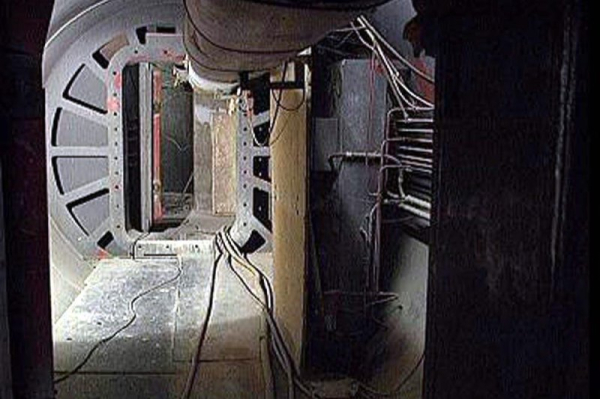
Any direct attack on the Bushehr light-water reactor could produce a Chernobyl-like disaster unleashing vast amounts of highly radioactive material. File Photo by EPA
The Trump administration argued that one crucial reason for launching Operation Epic Fury was to ensure Iran never developed nuclear weapons.
In June, Operation Midnight Hammer had “obliterated” Iran’s nuclear capability burying its supply of enriched uranium under tons of rubble.
That was all well and good.
But what about Iran’s plutonium? Plu-what? It turns out that in its Bushehr light water nuclear reactor facility, Iran has some 210 tons of “spent fuel.” Spent fuel consists of uranium rods used to fuel the reactor that have lost energy. To “recharge” these rods, they are reprocessed. And one of the byproducts is plutonium.
Plutonium 239 is weapons grade and is used more extensively in nuclear and thermonuclear weapons than uranium-235. Plutonium does not exist in meaningful amounts naturally. The physics are that U-238, the dominant isotope in nuclear fuel and not usable in a weapon, absorbs a neutron and decays into Pu-239.
It remains radioactive for a long time, with a half-life of more than 24,000 years.
Most people have never heard of plutonium or its use in weapons because of its advantages over highly enriched uranium (U‑235) rather than U‑238, the latter being the non‑fissile isotope.
“Fat Man,” the second U.S. A-bomb, which was dropped on Nagasaki in 1945, was made of Pu-239.
Pu-239 requires a smaller critical mass for detonation than U-235 and a higher fission cross-section, meaning it sustains a chain reaction more efficiently. Hence, lesser amounts of Pu-239 are needed in a weapon than U-235 — about 10 kilograms as opposed to roughly 52 kg.
But reprocessing spent fuel into Pu-239 is far more difficult than enriching U-238 into the explosive U-235. Enrichment is achieved by centrifuges that separate U-235 from U-238. Pu-239 is created through the more complex PUREX (Plutonium Uranium Extraction) process and a chemical reduction and repetitive purification cycle.
Pu-239 weapons are also more difficult to design. Pu-239 weapons contain small amounts of Pu-240 that can prevent an explosion. So, Pu-239 weapons require an implosion device that simultaneously and explosively compresses a plutonium sphere to cause a critical chain reaction unlike the simpler U-235 weapon that can be fired into a chamber to produce detonation.
What does this mean? If the fear is that Iran can or will build a nuclear weapon, destroying or neutralizing its supply of enriched uranium is only a partial solution.
But what about plutonium? What can or would the administration do about the plutonium option if Iran were to pursue it, and how aware of this issue is the White House, as it has not raised this issue publicly?
In the past, the agreement between Iran and Russia called for Russia to remove all the spent fuel from the Bushehr reactor. That transfer seems to be continuing. Further, it is unclear and probably unlikely that Iran has the capacity for reprocessing. But having a covert facility is not entirely out of the question, no matter how unlikely.
The inconsistency is obvious. U-235 is the problem calling for military action. Pu-239 is ignored or not perceived as a problem. To be fair, few good options are present for dealing with Pu-239.
Any direct attack on the Bushehr light-water reactor could produce a Chernobyl-like disaster unleashing vast amounts of highly radioactive material. Given the wind patterns, Russia and China would be affected.
A land attack to occupy and control the reactor and spent fuel would require hundreds of thousands of troops and is not susceptible to a hit-and-run raid like one that captured Venezuelan president Nicolas Maduro.
The only feasible option seems to be diplomacy and negotiation. The cooperation of Russia and Iran is needed to ensure the spent fuel is indeed removed and safely stored.
The larger question remains. One reason why the United States has lost every war it has started since the end of World War II is the lack of knowledge and understanding of its enemies. Has this fatal flaw been reinforced with Iran beyond misjudgments over Tehran’s ability to resist military attack and political decapitation?
A question that should be put to the White House is what about Bushehr, spent fuel and plutonium? An answer would be both welcomed and essential.
An absence of a good answer only raises further questions about the competence of this administration in launching its war against Iran.
Harlan Ullman is UPI’s Arnaud de Borchgrave Distinguished Columnist, senior adviser at Washington’s Atlantic Council, chairman of a private company and principal author of the doctrine of shock and awe. His next book, co-written with Field Marshal The Lord David Richards, former U.K. chief of defense and due out later this year, is Who Thinks Best Wins: How Decisive Strategic Thinking Will Prevent Global Chaos. The writer can be reached on X @harlankullman..
