

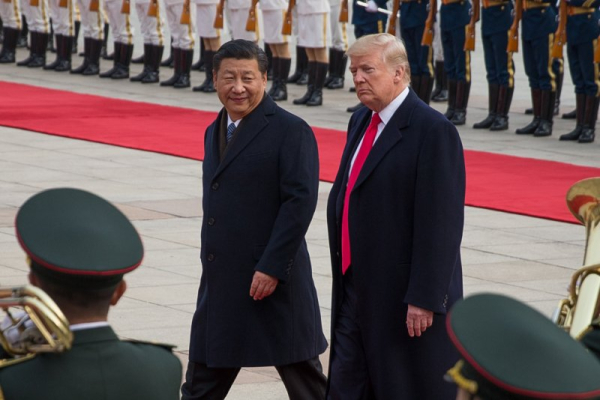
U.S. President Donald Trump (R) and Chinese President Xi Jinping review soldiers of the Chinese People’s Liberation Army honor guard during a welcome ceremony at the Great Hall of the People in Beijing in November 2017. File Photo by Roman Pilipey/EPA
The United Nations General Assembly has concluded, and now the world turns its gaze to Gyeongju, where the Asia-Pacific Economic Cooperation, or APEC, meeting convenes.
This gathering may prove an even grander stage than New York. The Oct. 31-Nov. 1 summit will be historic: the first joint visit by American and Chinese leaders to South Korea in 13 years, the first U.S.-China summit on Korean soil and the first summit between Donald Trump and Xi Jinping since 2019.
In an era where the international order is being redrawn along the lines of a new Cold War, the meeting of these two global titans has cast the world’s spotlight on Korea.
Speculation is rife that a dramatic reprise of the 2019 “Panmunjom surprise” — when the U.S. and North Korean leaders stood together at the border — could unfold. If it does, Gyeongju’s APEC summit will not merely be a diplomatic gathering; it will become a high-stakes barometer of global politics.
For Korea, the real focus is not the grandeur of the event, but whether it can project its own strategic will amid the swirl of great-power theater. Beyond the U.S.-China summit, Seoul faces a packed schedule: a Korea-China summit, a second Korea-U.S. summit and a first meeting with Japan’s new prime minister.
Each requires meticulous preparation, not symbolic gestures such as announcing a “clean-up week,” but concrete strategies with real consequence.
The U.S.-China summit: a limited priority
Undoubtedly, the world will focus on the U.S.-China summit. Yet, for Korea, its value is more limited. The most desirable outcome from Seoul’s perspective — progress on North Korea’s denuclearization — seems unlikely.
President Xi Jinping’s posture, underscored when he stood shoulder-to-shoulder with Kim Jong Un at China’s recent Victory Day celebrations, suggests little appetite for concessions. Any expectation that Beijing’s stance will soften during talks with Washington is more wishful than realistic.
Far more consequential for Seoul is the Korea-China summit, especially if Xi’s visit is elevated to the status of a state visit — the first since 2014. Symbolically, it would signal the restoration of relations that had cooled during the Yoon Suk Yeol administration.
But for President Lee Jae Myung, it will be a delicate challenge. Since taking office, he has reinforced the U.S.-Japan-Korea trilateral framework and repeatedly declared that the era of “security with America, economy with China” is over.
Meanwhile, Beijing has showcased its solidarity with North Korea and Russia in defiance of the West. Even as Lee told Time magazine that Seoul must “manage relations with China carefully so as not to provoke,” strengthening true strategic cooperation with Beijing remains an uphill battle.
Korea-China and Korea-U.S.: rough agendas
If the Korea-China talks advance to substance, the backlog of unresolved disputes will be formidable. The fact that the two neighbors have not held a leaders’ summit in over a decade speaks volumes.
If they do meet, the dialogue must be frank, dignified and anchored in reciprocity. Korea is not a subordinate but a sovereign state. The summit should demonstrate a mature diplomacy in which concessions and gains are balanced with confidence.
The second Korea-U.S. summit looms equally large. Ongoing tariff negotiations remain unsettled, spawning rumors and uncertainty. The delays have already created distortions. In some sectors, Korean tariffs now exceed Japan’s, placing Korean firms at a disadvantage. Seoul must use this summit to clear the air decisively, ensuring that Koreans feel they are treated as true allies, not afterthoughts.
The allocation of returns from Korea’s proposed $350 billion in U.S. investments also hangs unresolved. Lee has pledged that prior commitments between the two leaders will stand firm, but mounting domestic calls for renegotiation are narrowing his political room. Without clear progress in this summit, he may find himself cornered into reopening the deal.
Another pressing issue is visas. The fallout from the Georgia labor dispute revealed gaping flaws in the system for Korean professionals. While Washington has floated the idea of a special visa program, nothing has materialized. Meanwhile, surging visa fees have left Korean firms adrift. At the summit, Lee will face inevitable pressure to secure tangible relief.
Japan and the unpredictable North
A summit with Japan also is expected next month. With Tokyo in the midst of a leadership transition, the key question is whether the two-track framework that Lee and then-Prime Minister Shigeru Ishiba painstakingly built can be sustained under the incoming leader. APEC will offer the first clues.
But overshadowing all is the possibility — still speculative but increasingly plausible –of another surprise U.S.-North Korea summit. Kim Jong Un, in a Sept. 21 address to the Supreme People’s Assembly, declared he was willing to talk with Washington on the premise of being recognized as a nuclear power.
Trump has long boasted of maintaining a “good relationship” with Kim. Strikingly, in his recent 56-minute U.N speech, Trump did not utter the word “North Korea” once — a stark departure from his first term, when 3 of 4 such addresses gave it heavy emphasis. Experts read the silence as a deliberate move not to provoke Pyongyang, leaving the door ajar for talks.
If such a meeting materializes, Seoul cannot afford to be a spectator. The goal must be clear: dialogue not for its own sake, but toward the singular end of peace and eventual reunification — anchored on the premise of denuclearization. Korea should press Washington to reject any settlement that entrenches Pyongyang’s “two-state” campaign to enshrine permanent division.
Kim may try to leverage his ties with Moscow and Beijing, bolstered by sending troops to Russia’s war in Ukraine and attending China’s Victory Day parade, to coax Trump into legitimizing North Korea’s nuclear status. Washington must resist. Instead, it should stand by the vision for peaceful unification reaffirmed at the November 2024 trilateral summit with Korea and Japan.
Completing the “bridge”
If Lee succeeds in steering these converging summits — balancing China, solidifying commitments from Washington, stabilizing relations with Tokyo and shaping any potential U.S.-North Korea encounter — then his much-invoked “bridge” doctrine may finally take form.
A bridge is not built on spectacle but on solid foundations. This APEC summit will test whether Korea can lay those foundations not only for itself, but for peace and order in Northeast Asia.
Nohsok Choi is the former chief editor of the Kyunghyang Shinmun and former Paris correspondent. He currently serves as president of the Kyunghyang Shinmun Alumni Association, president of the Korean Media & Culture Forum and CEO of the YouTube channel One World TV.
