


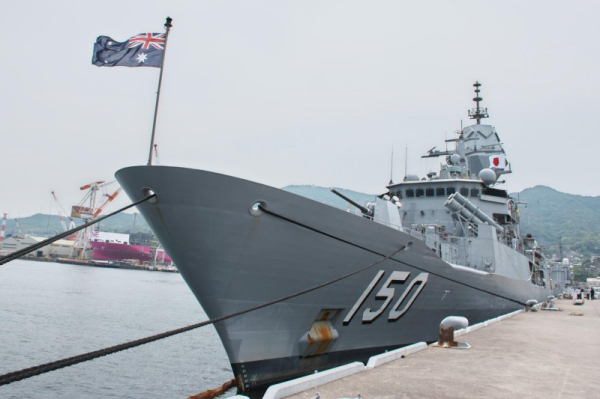
Royal Australian Navy HMAS Anzac (FFH 150) arrives at Japan Maritime Self-Defense Force Fleet Activities Kure in Hiroshima-Prefecture, Japan, in 2023. File Photo by Keizo Mori/UPI | License Photo
For years, Australia has expanded its military footprint in the South China Sea with broad political backing and relatively little cost.
Naval patrols, surveillance missions and joint exercises with allies have become routine features of Canberra’s regional strategy. But that approach may become harder to sustain if the geopolitical landscape changes.
This could entail a reduction in tensions between China and rival claimants, a calculated escalation from Beijing, or uncertainty about U.S. engagement in Asia.
A détente that sidelines Canberra
One potential challenge would be a diplomatic accommodation between Beijing and Manila, the parties involved in the South China Sea’s most active maritime confrontation.
China could, for example, tolerate a continued Philippine presence at some disputed features while retaining control over strategically important reefs where it has established military facilities.
Such an arrangement would likely reduce the risk of conflict, but it could also weaken the rationale for Australia’s continued security operations in the region.
Southeast Asian states may increasingly view Canberra’s involvement as unnecessary or even counterproductive if it appears to complicate a fragile détente. At the same time, Beijing would gain additional diplomatic space to pressure Australia to scale back its activities.
Escalation risks from Beijing
Absent a political settlement, China could seek to raise the costs of Australia’s involvement through limited coercive actions designed to remain below the threshold of armed conflict.
Such incidents might include a Chinese coast guard or naval drone damaging equipment aboard an Australian vessel, or Chinese fighter aircraft employing increasingly aggressive tactics against Australian patrol planes.
Beijing has already used flares against Australian surveillance aircraft over the South China Sea on two occasions in 2025, and previously against Australian and Canadian helicopters in the East China Sea.
A gradual increase in the volume or duration of flare deployments could be viewed by Chinese planners as a manageable escalation that signals resolve while avoiding a major confrontation.
While such actions would likely cause only limited damage, they would demonstrate Beijing’s willingness to impose costs on outside powers challenging its maritime claims.
From China’s perspective, targeting Australia may carry fewer diplomatic risks than confronting a Southeast Asian claimant. Escalating against an ASEAN member could undermine regional relationships, whereas Beijing may calculate that Canberra, with less direct stake in the dispute, would therefore be more vulnerable to pressure.
Such a scenario would also place Washington in a difficult position: either accept a setback suffered by a treaty ally or risk escalating a seemingly minor incident into a broader confrontation. Neither option would be attractive.
The AUKUS factor
Another possibility is that Washington could eventually expect Australia to deploy its future Virginia-class nuclear-powered submarines to the South China Sea under the AUKUS security partnership.
Compared with Australia’s aging conventional submarine fleet, the Virginia-class boats are optimized for long-range operations and would significantly expand Canberra’s undersea capabilities.
Because Australia will depend on U.S. technology, training and support to operate the submarines, Washington could retain considerable influence over how those assets are employed.
Australian submarines have long operated in the broader region. During the Cold War, the Royal Australian Navy’s Oberon-class submarines reportedly conducted intelligence-gathering missions against Soviet naval movements transiting Southeast Asian waters.
While contemporary operations remain classified, defense analysts generally regard the South China Sea as a key area of strategic interest for Australia’s submarine force.
The introduction of nuclear-powered submarines, however, could alter Beijing’s perception of Australia’s role. Their speed, endurance and stealth make them particularly suited for tracking ballistic missile submarines, a cornerstone of China’s nuclear deterrent.
China’s principal ballistic missile submarine base at Longpo, on Hainan Island, sits at the northern edge of the South China Sea.
Whether or not Australia would ever participate in such missions, Chinese military planners are likely to view any Australian nuclear-powered submarine operating in the region through that lens. This alone could place Australia on a lasting, confrontational strategic footing.
Strategic uncertainty ahead
The future trajectory of Australia’s South China Sea policy will also depend heavily on the capabilities and intentions of the United States.
If Australian leaders conclude that Washington is becoming less willing or able to sustain a robust regional presence, Canberra may become more cautious about surveillance flights and freedom of navigation patrols.
Conversely, a more assertive U.S. strategy could raise concerns within Australia about becoming entangled in an intensifying U.S.-China rivalry, including about the nuclear dimensions associated with AUKUS.
For now, Australia appears committed to maintaining its current level of activity in the South China Sea. Yet that position is not fixed.
Diplomatic breakthroughs, limited military incidents, or evolving alliance expectations could rapidly alter Canberra’s assessment of the costs and benefits of remaining an active security player in one of the world’s most contested maritime regions.
Frank Yuan ([email protected]) holds a PhD from the University of Sydney. He is currently an adjunct fellow at the Australia-China Relations Institute at the University of Technology Sydney. He can be found on Twitter/X as @Yuan_Frank0. This article is republished with permission from the South China Sea NewsWire. Read the original article. The views and opinions expressed in this commentary are solely those of the author.
