


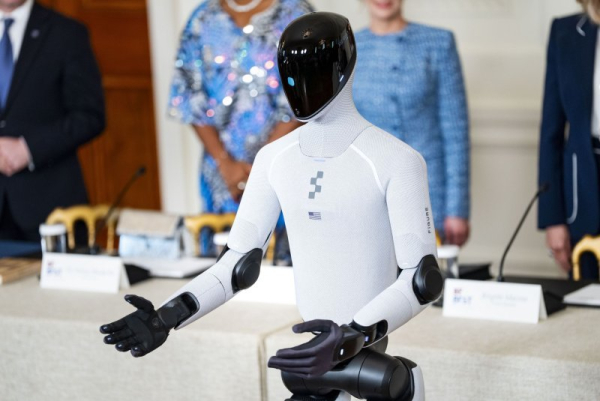
Figure 03, a humanoid robot, speaks during the Fostering the Future Together Global Coalition Summit roundtable in the East Room of the White House in Washington, D.C., on March 25. File Photo by Bonnie Cash/UPI | License Photo
Like tectonic plates colliding beneath the surface, humanism and the humanities are confronting movements that question long-held definitions of the human person.
This is more than an academic dispute. Advances in artificial intelligence, biotechnology and human enhancement are forcing society to reconsider where the natural ends and the artificial begins. They also raise an urgent question: will technology remain at the service of humanity, or will human beings gradually adapt to the demands of the systems they have created?
Faced with this dizzying, monumental shift that threatens the human condition, the great voices of secular philosophy and thought have fallen silent. The silence of institutions entrusted with safeguarding humanist principles and ethical values is troubling.
Three visions of humanity
Humanism emerged during the Renaissance and matured through the Enlightenment. It places the human person at the center of moral and intellectual life, resting on human dignity and confidence in reason.
Humanism holds that people can improve society through education and ethical conduct, and that human beings share a nature that transcends historical or cultural difference.
Transhumanism goes further. Associated with thinkers such as Nick Bostrom, it advocates using science and technology to enhance physical and cognitive capacities, treating human biology not as evolution’s endpoint but as something to be deliberately improved.
Transhumanists hope to overcome disease and aging. Some envision radical life extension or closer integration between brain and machine; others anticipate beings whose abilities exceed current humanity’s. Bostrom has described human nature as a “work in progress” that enhancement technologies may transform.
Transhumanism shares humanism’s confidence in reason and progress, but where humanism seeks to develop the person, transhumanism is willing to redesign it.
Posthumanism presents a different challenge. It is not simply a program for replacing people with machines, as it is sometimes portrayed. Philosophers such as Rosi Braidotti question the assumption that humanity stands separate from, and superior to, the rest of existence.
Posthumanism criticizes the image of the autonomous human subject as the universal measure of reality. It holds that people exist through relationships with other people, ecosystems and technological systems, and it challenges the rigid boundary between human and machine, natural and artificial.
These ideas can correct real forms of human arrogance. But they also carry risk: if concern for anthropocentrism goes too far, it can deny that the human person has a distinctive dignity and moral responsibility.
The temptation of technological idolatry
Pope Leo XIV brought this debate into sharper focus in his first encyclical, Magnifica Humanitas, published in May. It calls for safeguarding the human person in the age of artificial intelligence, judging technological development against the common good and the dignity of every person.
The danger is not technology itself; science has relieved suffering and expanded human possibility. The danger arises when technological power is treated with something close to religious reverence, and every human limitation is assumed fixable. That temptation encourages society to ask whether something is possible before asking whether it is good.
Futurist Ray Kurzweil has predicted that artificial intelligence will surpass human intelligence, transforming civilization irreversibly around 2045. He also expects medical progress to reach what is commonly called longevity escape velocity, when advances extend life expectancy faster than people age.
Such forecasts remain speculative, and matter less for their dates than for the direction of development they describe. Scientific and commercial institutions are already pursuing longer life, genetic modification and closer integration between human cognition and machines.
Latin America’s stake in the debate
Latin America cannot afford to sit out this debate as a passive consumer of systems designed elsewhere. The region is adopting artificial intelligence rapidly, but it continues to face gaps in infrastructure, investment and specialized talent. The 2025 Latin American Artificial Intelligence Index identified Chile, Brazil and Uruguay as regional leaders while documenting wide disparities among the 19 countries it studied.
The region’s own history sharpens the stakes. Societies marked by social exclusion and concentrated economic power have particular reason to ask who benefits from new technologies, and who is left out.
If genetic enhancement, advanced medicine or cognitive augmentation become available only to wealthy minorities, inequality could become biological as well as economic. If automated systems make decisions about employment, education or public services without transparency, old injustices can resurface behind the appearance of neutrality.
This is why the humanism-transhumanism-posthumanism debate is not merely academic for the region. How Latin American societies answer it will help determine whether artificial intelligence narrows the gap with wealthier economies or creates new forms of inequality, even biological ones.
What the debate turns on
These regional concerns lead back to the deeper philosophical question. Encyclicals do not settle policy questions, but Magnifica Humanitas frames the underlying one clearly: whether societies will use technology to relieve suffering while respecting the human condition, or come to regard every limitation, including aging and vulnerability, as a defect to be engineered away. UNESCO’s guidance on AI governance stakes out similar ground, warning that unregulated development can deepen the inequalities it claims to solve.
The debate between humanism, transhumanism and posthumanism is ultimately about which position gets to define progress. Each carries a partial truth: humanism’s insistence on dignity, transhumanism’s confidence that suffering can be reduced, posthumanism’s warning against human arrogance toward the rest of existence. None resolves the tension on its own.
That tension resists a tidy resolution, in Latin America or anywhere else. It is not a question engineers, corporations or governments can settle alone, because it is ultimately about what a human life is for. Technology will keep advancing regardless of how it is answered. What remains open is which understanding of the human person guides that advance, and, in a region still defining its place in the AI economy, who gets to decide.
Carlos Cantero is a Chilean academic at the International University of La Rioja in Spain and the author of Digital Society: Reason and Emotion. An international lecturer, adviser and consultant, he focuses on adaptability in the digital society, ethics, social innovation and human development. The views and opinions expressed in this commentary are solely those of the author.
