

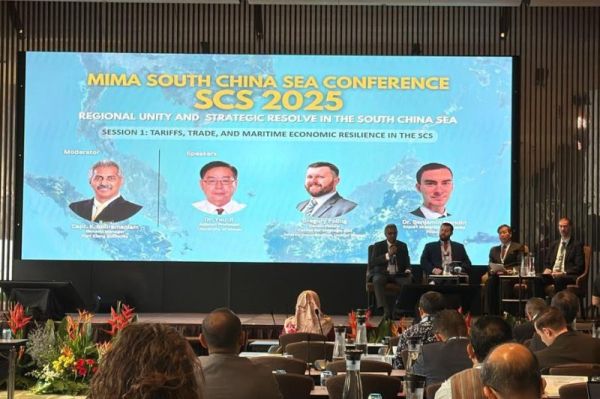
1 of 2 | The issues related to the South China Sea are discussed at the Maritime Institute of Malaysia South China Sea Conference on Nov. 17 and 18 in Kuala Lumpur. Photo courtesy of Benjamin Blandin
A wave of maritime conferences across Southeast Asia and China this fall suggests a subtle, but notable, shift in how regional governments are approaching the South China Sea.
Long defined by sovereignty disputes, military build-ups and legal wrangling, the contested waters are now being framed as an environmental emergency — with collapsing fish stocks, bleaching reefs and rising climate threats pressing states toward new dialogue.
In early November, the Philippines hosted the Manila Dialogue on the South China Sea, a three-day forum that brought together diplomats, military officers, academics and policymakers to discuss crisis-prevention, fisheries enforcement and confidence-building — topics that only recently entered the mainstream of official talks.
The discussions followed the 17th South China Sea International Conference in Da Nang, Vietnam, held just two days earlier. Organized by the Diplomatic Academy of Vietnam under the theme “Unity in Uncertainties,” the gathering drew more than 300 participants, including legal scholars, naval strategists, business leaders and environmental experts.
Their focus: how to shift from disputes and deterrence toward cooperation on fisheries, environmental protection, marine science, and search-and-rescue protocols.
“Security, climate impacts and economic stability are converging — and no single country can manage these challenges alone,” said one Southeast Asian maritime researcher who attended both meetings.
Urgency at sea — and on the shore
For coastal communities, the stakes are increasingly visible. Regional studies show fish stocks in the South China Sea have fallen more than 70% since the 1950s. Also, 80% of the region’s coral reefs have been degraded or under serious threats from acidification, overfishing and destructive fishing practices.
Meanwhile, Vietnam, Indonesia and the Philippines — all major seafood exporters — depend on stable access to fisheries for food security and coastal economies.
Climate signals are accelerating. Mass bleaching was recorded across the South China Sea in 2024, and ocean acidification is already reshaping key reef systems. Illegal, unreported and unregulated fishing continues across contested waters, often pushing small fishers into danger zones where maritime militia, coast guards and commercial fleets overlap.
Officials at both Manila and Da Nang warned that without coordinated action, the sea could become not just contested but also ecologically irreparable, with destabilizing political consequences. The death of coral reefs means food insecurity because 1billion people rely on those ecosystems for sustenance or work.
The surge in diplomacy isn’t limited to Vietnam, the Philippines and China.
Kuala Lumpur also entered the conversation this fall, hosting the Eighth Annual South China Sea Conference under the theme “Regional Unity and Strategic Resolve” on November 17 and 18. The gathering drew officials, naval officers and policy researchers from across ASEAN, adding another signal that conversation around the South China Sea is widening in both frequency and geography.
Some analysts say Malaysia’s convening role — traditionally quieter than those of Hanoi or Manila — underscores how environmental pressures and rising escalation risks are now forcing even more neutral actors to step forward.
The Kuala Lumpur conference, they note, placed equal weight on maritime law enforcement, environmental protection and operational safety at sea — a balance rarely seen in earlier years dominated by sovereignty disputes.
Benjamin Blandin, a nonresident fellow with the Yokosuka Council on Asia-Pacific Studies, who attended the Malaysia forum, said the urgency is rising as ecological damage becomes harder to ignore. He pointed to what he described as alarming degradation in the Spratly Islands, where more than 22,000 acres of coral reefs have been destroyed or severely damaged.
“We’re running out of time – the environmental decline is no longer theoretical,” he said.
China to host next track
The next meeting in this evolving diplomatic cycle will be held December 10 to 12 in Hainan, China, where the Huayang Center for Maritime Cooperation and Ocean Governance will convene an international symposium on global ocean governance. While not formally tied to territorial disputes, participants expect the South China Sea to dominate discussions.
For China, even entertaining multilateral discussions marks a significant departure from its traditional preference for bilateral negotiations and tightly controlled diplomatic formats.
Analysts say the upcoming forum in Hainan — at which organizers plan to review cooperative marine models used in the Mediterranean and Pacific fisheries systems — signals that Beijing may be testing whether environmental frameworks can serve as lower-risk entry points for broader engagement.
While officials have not publicly framed the event as a South China Sea initiative, the agenda has fueled speculation that China is exploring multilateral environmental diplomacy as a way to ease tensions without touching core sovereignty claims.
A shift in tone, not yet in policy
Despite growing dialogue, the geopolitical fundamentals remain unchanged. Coast guard water-cannon confrontations continue, and no claimant has altered its territorial position.
“Cooperation has always existed alongside dispute,” said Nong Hong, executive director of the Washington-based Institute for China-America Studies. “Forums on marine science, fisheries management and joint search-and-rescue have been held for years. These conversations are not new. What matters is whether states can translate them into implementation.”
Analysts say early signs show the regional tone is shifting. Technical working groups on fisheries monitoring, marine debris and joint scientific expeditions, stalled for years, are slowly re-emerging. Across recent forums, the idea of “science diplomacy” surfaced repeatedly as a practical tool to build trust through shared research rather than rhetoric.
China, meanwhile, is positioning itself as a leader in the environmental space, highlighted by its hosting of the 5th World Congress of Biosphere Reserves in Hangzhou, the first time the global gathering has been held in Asia.
China joined UNESCO’s Man and the Biosphere program in 1973 and has since expanded its conservation footprint. The country now counts more than 270 marine protected areas, including 34 nature sites recognized as official UNESCO biosphere reserves.
The effort mirrors goals outlined in the Hangzhou Strategic Action Plan, which calls for protecting critical habitats, restoring damaged ecosystems and improving connectivity across marine corridors.
China has designated about 4.1% of its waters as marine protected areas, but analysts say enforcement and coordination remain uneven, with several zones still operating as isolated or loosely managed sites. Whether China’s growing environmental posture reflects genuine policy or soft-power messaging remains debated.
“Vietnam and China already have some joint patrols and cooperative exchanges in the Gulf of Tonkin. Perhaps they could extend this model to areas of dispute such as the Paracels and Spratly Islands,” said Hunter Marston, an adjunct fellow at Center for Strategic Advance Studies in Washington.
What is clear is that Beijing has been laying the narrative groundwork for years. A decade ago, Chinese officials began to publicly promote international marine research and cooperation as part of the country’s long-term ocean strategy.
At the time, Chen Lianzeng, of the State Oceanic Administration, said global marine science had entered “a new stage” driven by cross-disciplinary research and international collaboration –remarks made after the annual North Pacific Marine Science Organization meeting.
One proposal gaining quiet momentum is a networked system of marine protected areas covering ecologically sensitive sites such as the Spratly ecosystem and Scarborough Shoal — a model that would not prejudice sovereignty claims.
Earlier this fall, China proposed creating a marine nature reserve at Scarborough Shoal, a disputed reef claimed by both Beijing and Manila. In a recent commentary for the Center for Strategic and International Studies Asia Maritime Transparency Initiative, a Washington-based foreign policy think tank, legal scholar Vu Hai Dang suggested the plan could open space for cooperation rather than confrontation, beginning with joint marine scientific research at the shoal.
Such collaboration, he noted, would help both sides establish a shared understanding of the reef’s ecological condition without relying on unilateral data. Under Article 246 of United Nations Convention on the Law of the Sea, scientific research cannot be used to justify sovereignty claims, meaning joint studies would not affect either side’s legal position. Dang argues that beyond environmental benefit, coordinated research could serve as a confidence-building step, lowering tensions and restoring dialogue in one of the region’s most contested waters.
Why now?
Regional analysts say three forces are driving this shift. Rising escalation risks as more civilian and military vessels operate in close proximity; growing economic pressure tied to the European Union’s expanding rules on illegal, unreported and unregulated fishing; and mounting climate impacts, including warming waters and extreme weather affecting food security and seafood export markets.
Together, these trends are reshaping how governments define security in the South China Sea. Professor Carlyle Thayer, emeritus scholar at the University of New South Wales Canberra, said the recent conferences in Da Nang and Manila may offer a foundation for discussions on practical cooperation, particularly on marine management and ocean governance — areas that have historically lagged behind territorial and military debates.
Pause or turning point?
Whether this environmental turn represents a durable diplomatic opening or simply a tactical pause remains unclear. Naval modernization continues across the region and mistrust between claimant states persists.
One regional scholar who requested anonymity said the recent forums appear to be “more signaling than substance,” adding that if organizers want progress, they will need to move beyond speechmaking and toward formats that generate actionable frameworks rather than more dialogue.
Still, the clustering of recent conferences signals a growing recognition that environmental collapse could become as destabilizing as territorial conflict.
Calls for a regional marine protected area network in the South China Sea aren’t new.
In 1992, University of Miami marine biologist John McManus proposed creating a “marine peace park” in the Spratly Islands, arguing the reefs function as a biological “savings bank” for the region.
Fish that spawn there, he said, circulate through the coastal waters of nearly every claimant state before returning, making shared protection critical to long-term sustainability.
Diplomats and scientists say the region is nearing a tipping point in which declining fish stocks, reef degradation and warming waters begin shaping national security decisions as much as sovereignty claims. The emerging view, they say, is that failure to act on climate and marine degradation could fuel the very instability governments have spent years trying to prevent.
For now, the South China Sea appears to be testing a new dual-track formula: deterrence above water and cooperation beneath it.
