

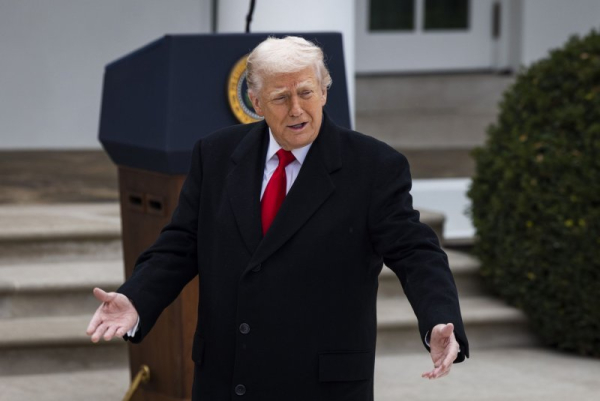
President Donald Trump faces criticism, some from his own party, for a series of actions over the last few weeks. Photo by Jim Lo Scalzo/UPI | License Photo
At long last, has President Donald Trump finally outsmarted himself? Will this current series of seemingly self-destructive actions finally crack his thus-far impenetrable political armor? Or will they only make a small dent? Four self-generated actions recently are illustrative.
That Tucker Carlson television interview of Nick Fuentes, whose views extended beyond being merely borderline racist and anti-Semitic, could attract the attention of the president is extraordinary. Free speech is to be defended. But why did Trump even comment on this?
Despite the intransigence of both parties, Congress finally voted to reopen the government after a six-week shutdown. The point of maximum contention was healthcare. Cuts, especially to Medicaid, clearly hurt millions of Americans, many of them MAGA supporters. The costs of health insurance coverage for some 42 million Americans are expected to soar.
Clearly, the Democrats’ demand for $1.2 trillion to extend benefits was rejected as a budget buster. But, who will take the bulk of the blame and responsibility for the shutdown?
In a civil society, it would seem that two parties would negotiate much sooner. And a responsible president should lead these negotiations when a shutdown harmed so many Americans. Trump did not.
Congress, with only one dissenting vote, cleared the way for release of the so-called Epstein files. The last time such a one-sided vote took place, perhaps, was the 1964 Tonkin Gulf Resolution, with only two dissents. That vote led to the Vietnam disaster. Will the Epstein vote lead to an equivalent political disaster for Trump?
At first, Trump promised to make all the Epstein material public. So did his attorney general, Pam Bondi, asserting she had seen the file. Then, she declared there was no file. It seems to vanish mysteriously.
Trump did everything he could to prevent the release of what his attorney had declared did not exist. Why? The assumption was that something very bad for Trump was lurking in those missing documents.
Was Trump worried that he and Epstein were much closer than, in retrospect, was proper? Was Trump fearful that some of his best-heeled and richest supporters would be outed? Or were there other reasons? No one except Trump knows.
The visit of Saudi Crown Prince Mohammed bin Salman, known as MBS, ignited a firestorm over his role in the gruesome murder of Washington Post writer Jamal Khashoggi in 2018 at the hands of Saudi agents in Turkey.
U.S. intelligence determined MBS gave the assassination order. When a television reporter raised the question Nov. 18, Trump immediately and forcefully defended the prince by attacking ABC’s Mary Bruce for daring to raise such a question and insulting “our” guest and my “very close” friend.
Further, Trump has now made “transactional” actions the new way of doing business. The past is no longer relevant if deals are to be made and if America is to become great again by his definition.
Not only was MBS a reflection of this, but the billions of dollars Trump family members are making from Saudi deals also amplify this reality.
Trump fell in love with North Korea’s Kim Jong Un. And Russian President Vladimir Putin had a certain spell over Trump that, if the proposed Ukrainian peace deal evolves as described, will come at the expense of Ukraine President Volodymyr Zelensky.
Societies often follow their leaders. The Kennedys, Jack and Jackie, reintroduced style and elegance to Americans. And many times, the public does not mirror leaders. President Jimmy Carter’s seemingly holier-than-thou attitude did not create masses of admirers.
What impressions will these potential acts of Trump’s self-destruction acts have on the American public? American values have so far trumped transactional politics. Compared with the distasteful way the Trump family is profiting from the presidency, poor Hunter Biden’s contract with Burisma, a Ukrainian energy company, seems trivial by comparison.
Given the convergence of these destructive acts — indefensible support of Tucker Carlson; delaying the reopening of government; reversals in making public the Epstein files; and the MBS visit — will these form a critical political nuclear reaction?
Will the Epstein revelations not only embarrass Trump, but also do more and even irreversible political damage to him? Will the way Trump has ignored his intelligence agencies and embraced MBS — while his family profits — finally convince Americans that transactional politics isn’t what we do? We will see.
Trump’s armor may still be working. Yet, these generated acts of massive self-destruction may indeed prove too explosive to contain.
Harlan Ullman is UPI’s Arnaud de Borchgrave Distinguished Columnist; senior adviser at Washington’s Atlantic Council, chairman of a private company and principal author of the doctrine of shock and awe. His next book, co-written with Field Marshal The Lord David Richards, former U.K. chief of defense and due out next year, is Who Thinks Best Wins: Preventing Strategic Catastrophe. The writer can be reached on X @harlankullman.
