

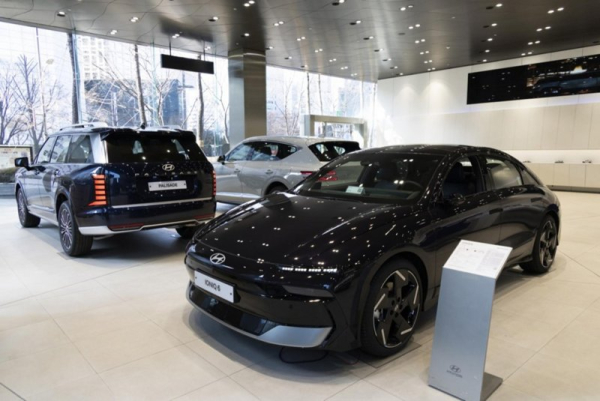
Hyundai cars are displayed at a showroom in Seoul, South Korea, 27 January 2026. File. Photo by JEON HEON-KYUN/ EPA
This commentary was contributed by Moon Hak-hoon, professor of future electric vehicles at Osan University.
A U.S. Supreme Court ruling has reshaped Washington’s tariff policy, prompting a new phase in global trade tensions while leaving key questions for South Korea’s auto industry.
In a 6-3 decision on Feb. 20, the court ruled that tariffs imposed under the International Emergency Economic Powers Act were unlawful. The decision immediately nullified so-called reciprocal tariffs and fentanyl-related duties previously applied to countries including Mexico, Canada and China.
The White House responded the same day by invoking Section 122 of the Trade Act, allowing temporary tariffs of up to 15% for as long as 150 days in cases involving balance-of-payments concerns or currency instability. President Donald Trump imposed a 10% universal tariff on imports and signaled plans to raise it to the 15% ceiling.
The shift represents more than a legal adjustment. It marks a structural change in how tariffs are applied. Passenger vehicles and auto parts were excluded from the new 10% to 15% tariffs, largely due to concerns about domestic inflation, but existing measures under Section 232 of the Trade Expansion Act remain in place.
Because Section 122 tariffs require congressional approval to extend beyond 150 days, domestic political divisions in Washington are now a key variable shaping the trade outlook.
Against this backdrop, South Korea faces pressure to secure favorable treatment. Officials and manufacturers are expected to emphasize the bilateral free trade agreement and highlight South Korea’s status as a key U.S. ally to seek exemptions or reduced rates.
Industry analysts say investment by South Korean firms in the United States could play a central role in negotiations. Hyundai Motor Group’s large-scale manufacturing and employment footprint, including its Georgia plant, is seen as a potential bargaining tool.
Automakers are also preparing for a prolonged period of elevated trade barriers. Expanding U.S.-based production remains the most direct way to avoid tariffs, reinforcing the importance of “Made in USA” strategies. At the same time, companies must manage the risk of reduced domestic output and potential job losses in South Korea.
To remain competitive, manufacturers are accelerating efforts to cut costs through smart factory systems, robotics and artificial intelligence-driven production. Diversifying supply chains and adopting flexible sourcing strategies are also viewed as essential to respond quickly to shifting U.S. trade policies.
Experts say tariffs should now be treated as a constant factor in global trade. Rather than focusing solely on rate reductions, South Korea may need to position itself as an indispensable economic partner in the U.S. market.
However, the transition raises longer-term challenges. As production shifts abroad, policymakers and companies must find ways to repurpose domestic facilities. Converting them into high-value manufacturing hubs for advanced vehicles, purpose-built mobility and robotics is emerging as a key strategy to preserve jobs and sustain industrial competitiveness.
— Reported by Asia Today; translated by UPI
© Asia Today. Unauthorized reproduction or redistribution prohibited.
Original Korean report: https://www.asiatoday.co.kr/kn/view.php?key=20260317010005074
