

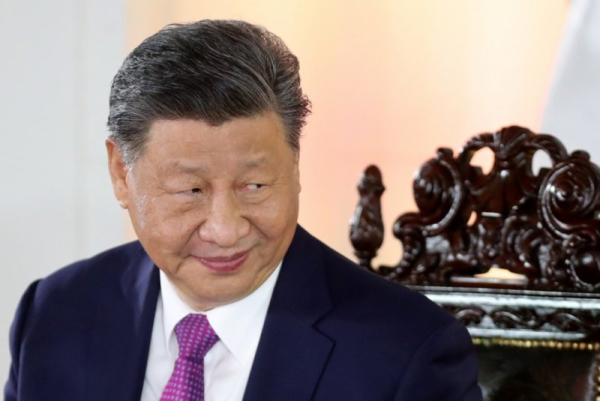
Chinese President Xi Jinping attends an inauguration event for the Chancay mega-port at the Government Palace in Lima, Peru,in 2024. File Photo by Paolo Aguilar/EPA
In recent weeks, Peru has found itself at the center of intensifying geopolitical attention. What appears at first glance to be infrastructure development and commercial expansion is increasingly viewed through a broader strategic lens: the growing competition between China and the United States in Latin America.
China’s relationship with Peru is longstanding and multifaceted. A significant Chinese-descendant community has been part of Peruvian society for generations, particularly in commerce and gastronomy. That cultural integration is not in dispute. What is now being debated is the scale and strategic depth of Beijing’s state-linked investments.
China has been Peru’s largest trading partner for more than a decade. In 2023, bilateral trade exceeded $35 billion, driven primarily by copper, iron ore and agricultural exports. Chinese companies control or hold major stakes in several of Peru’s largest mining operations, including the Las Bambas copper mine.
A regional pattern with a Peruvian focal point
Peru is not alone in navigating this dynamic. Across Latin America, Chinese firms have secured major roles in strategic infrastructure, including port facilities in Panama, energy and mining assets in Ecuador, and extensive investments in Brazil’s electricity transmission and agricultural sectors. What distinguishes Peru is the combination of large-scale mineral wealth and access to the Pacific, coupled with relative institutional stability — attributes that make it a focal point for both global powers.
The most emblematic project is the Port of Chancay, a $3.5 billion deep-water megaport north of Lima. The project is led by the Chinese state-owned shipping giant COSCO, which holds a 60% controlling stake. Once fully operational, the port is expected to reduce shipping times between Peru and Asia by up to 10 days and position Peru as a major logistics hub for South America’s Pacific coast.
Supporters view Chancay as transformative infrastructure that will enhance Peru’s competitiveness and attract regional trade. Critics argue that the majority of foreign control over such a strategic maritime gateway raises legitimate concerns regarding sovereignty and national security. The debate is no longer simply economic; it is geopolitical.
Beyond infrastructure: institutional ties
China’s engagement extends beyond ports and mines. Over the past 15 years, Peruvian political leaders across the ideological spectrum have participated in official visits and Beijing-sponsored forums. Several Peruvian universities host Confucius Institutes. Taken together, these overlapping channels of influence represent a sustained strategy of institutional relationship-building that deepens long-term ties and cultivates familiarity with Chinese governance models.
Washington responds
Meanwhile, Washington has renewed its attention to the region. U.S. officials have expressed concern about China’s expanding footprint in critical infrastructure throughout Latin America. In Peru, the recent appointment of Ambassador Bernie Navarro, who maintains close ties to Secretary of State Marco Rubio, signals increased diplomatic engagement. The designation of Peru as a Major Non-NATO Ally, formalized in January 2026, strengthens bilateral defense cooperation and underscores U.S. strategic interest.
Geography and timing
Peru’s geography enhances its importance. Situated along key Pacific trade routes and endowed with vast natural resources, the country represents a strategic bridge between South America and Asia. Compared with several regional peers, Peru has maintained relatively solid macroeconomic fundamentals and fiscal discipline.
The timing adds further complexity. In 2026, Peru will hold general, regional and municipal elections, leading to a full renewal of political leadership. Foreign investment and national sovereignty may become defining issues in the campaign. Political parties will likely face pressure to articulate clearer positions regarding relations with both China and the United States.
Sovereignty in a competitive age
The question facing Peru is not whether it should engage with either power. As a sovereign nation integrated into the global economy, it will continue to work with both. The central issue is how Peru can ensure that external partnerships strengthen national development while preserving long-term autonomy and institutional integrity.
At a moment when global competition is increasingly defined by control of supply chains, ports and strategic minerals, Peru stands at a pivotal juncture. The answers will not emerge from abstract debate. They will be shaped in ministries, in Congress, and ultimately at the ballot box, beginning with the 2026 elections.
Gustavo Nakamura is Regional Director in Peru for CEFAS CEU (Ibero-American Center for University Studies), where he focuses on geopolitical analysis and institutional development in Latin America. The views and opinions expressed in this commentary are solely those of the author.
