

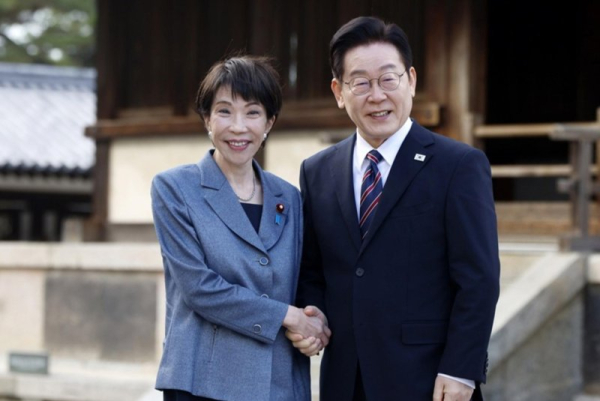
Japanese Prime Minister Sanae Takaichi (L) and South Korean President Lee Jae Myung pose for photographs as they visit the Western Precinct, Saiin Garan, at Horyu-ji temple in Ikaruga, Nara prefecture, in western Japan in January during Myung’s two-day visit to Japan. Photo by Franck Robichon/Pool/EPA
SEOUL — The atmosphere of supreme hospitality displayed between President Lee Jae Myung and Prime Minister Sanae Takaichi in January is poised to further energize both diplomatic ties and private-sector exchanges.
This follows Takaichi’s landslide victory in the lower house election on Jan. 9, where the Liberal Democratic Party established a “one-strong” dominance — the largest post-war victory — signaling a period of sustained leadership.
This political stability is naturally expected to deepen the “New Era of Korea-Japan Relations” and accelerate the private-sector exchanges agreed upon at the summit, with a particular emphasis on the youth and adolescent generations.
At the summit held last month in Nara, the Prime Minister’s hometown, Japan’s “Omotenashi” diplomacy became a central theme.
In an unprecedented breach of protocol, Takaichi personally greeted Lee at the hotel entrance. This Omotenashi — the essence of wholehearted, selfless hospitality — was further symbolized by the two leaders’ impromptu drum performance.
This rapport broke a long-standing deadlock, leading to a breakthrough agreement on the joint DNA identification of Korean victims at Japan’s Chosei coal mine.
The warm encounter catalyzed a comprehensive agreement to expand the scope of all-encompassing private-sector exchanges, specifically targeting:
- Economic, industrial, cultural, and sports sectors;Strengthening education and professional talent development;Reinforcing institutional support and foundational infrastructure;The quantitative and qualitative expansion of exchange programs for future generations.
As a result, the two nations have begun constructing a future of reconciliation rather than conflict, fostering an unprecedented climate of cooperation.
This cooperative spirit has long been brewing beneath the surface across various sectors and has now reached a substantive inflection point under the leadership of the two heads of state.
Amid speculation that the LDP’s landslide victory could lead to constitutional revision and a more “war-capable” Japan, critics warn of rising regional tensions, while supporters call it a normalization of defense policy. Whatever the outcome of that debate, long-term stability may depend as much on civilian exchange as on security policy.
With that in mind, I asked an AI to recommend restaurants in the Gyeongbokgung Palace area run by Japanese chefs. The results cascaded in an endless stream; among the numerous recommendations, establishments such as “Seochon Nuha-no-mori” appeared instantly.
If such a vibrant Japanese culinary presence exists in just one specific area, the scale of integration nationwide must be immense. Witnessing this atmosphere, I found hope that if the various summit agreements move beyond declarations into actual operation, they will broaden mutual understanding and lead to substantive cooperation.
This is a hope that we will transition into a true New Era that overcomes past conflicts and brings mutual benefits — not only for the present but for our children, daughters, and grandchildren.
Private-sector exchanges support this hope.
In 2025, bilateral travel reached 13 million visitors. Notably, approximately 9.5 million Koreans visited Japan — a 7.3% increase from 2024 — making Koreans the top group of visitors to Japan.
Meanwhile, about 3.2 million Japanese visited Korea, ranking second among all foreign visitors to Korea in 2025. Citizens of both nations are already visiting not just Seoul and Tokyo, but rural corners of both countries, expanding the scope of exchange by understanding each other’s culture and lifestyles.
Moreover, the number of youth from both countries seeking employment or study abroad is surging. According to South Korean Ministry of Justice statistics, Japanese nationals residing in Korea on long-term visas reached 28,911 as of October 2025, a 12.6% increase compared to the same month of the previous year.
Specifically, as of October 2025 and compared to October 2019, those on E-7 (specialized occupation) visas rose by 37.7%, while C-4 (short-term employment) rose by 384% and D-4 (job-seeking) visas surged by 484%.
This indicates that a reciprocal “import of talent” from Japan has begun. This trend is particularly remarkable because it is occurring despite Japan’s university graduate employment rate reaching 98.1% in 2025, suggesting it is driven by a genuine rise in mutual affinity.
An October 2025 survey showed Japanese favorability toward Korea reached 42.2%, doubling in the seven years since the first survey in 2018 found it at 20%, the South Korea Ministry of Culture, Sports and Tourism reported.
Conversely, a survey by Japan’s Shinbun Tsushin Chosakai showed Korean favorability toward Japan reached 56.4% in 2025, exceeding 50% for the first time since the survey began in 2014.
Crucially, with Korea’s per capita GNI ($36,914) surpassing Japan’s ($35,793), according to the Bank of Korea’s 2025 announcement, the two nations can interact from a position of economic parity.
This equality serves as a vital safeguard — even if Japan undergoes a constitutional transformation, the risk of mutual conflict is significantly mitigated when both nations engage as equal stakeholders.
I propose that we further deepen this paradigm of cooperation over conflict by harmonizing Japan’s meticulous Omotenashi with Korea’s traditional “Barefoot Hospitality”: The profound, unbridled warmth of rushing out to greet a guest with such overwhelming joy that one forgets to even put on shoes.
Nohsok Choi is the former chief editor of the Kyunghyang Shinmun and former Pariscorrespondent. He currently serves as president of the Kyunghyang Shinmun Alumni3Association, President of the Korean Media & Culture Forum, and CEO of the YouTubechannel One World TV.
Pride flag returns to Stonewall National Monument
Supporters watch as local politicians and others raise an LGBTQ+ pride flag at the Stonewall National Monument in New York City on February 12, 2026. Photo by John Angelillo/UPI | License Photo
