


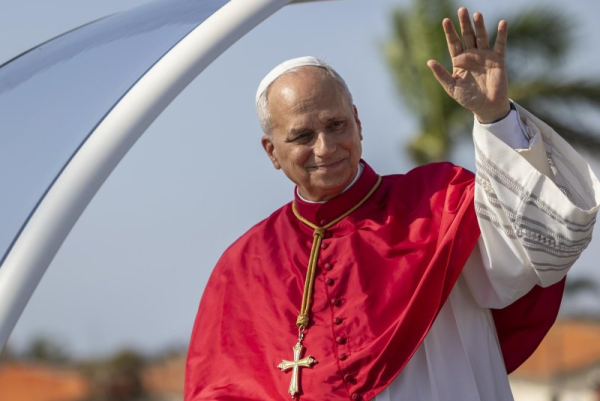
Pope Leo XIV’s encyclical Magnifica Humanitas (“Magnificent Humanity”) has placed one of the great questions of our time at the center of global debate: How can humanity govern artificial intelligence without losing sight of the human person? File Photo by Jose Sena Goulao/EPA
Pope Leo XIV’s encyclical Magnifica Humanitas (“Magnificent Humanity”) has placed one of the great questions of our time at the center of global debate: How can humanity govern artificial intelligence without losing sight of the human person?
The document addresses the ethical implications of generative artificial intelligence and the concentrated power of those who design and control its platforms. It warns against technological power exercised without moral direction or public accountability, and against progress that weakens rather than strengthens human dignity.
Some have praised the pope’s moral leadership. Others have welcomed the Church’s willingness to challenge the political and technological powers shaping the digital age. Still others have responded with indifference or criticism, arguing that religious institutions have often resisted progress and may be doing so once again.
Across history, religious and secular traditions have often ignored or misunderstood one another. Yet the scale of today’s technological challenge demands a broader conversation. Artificial intelligence and digital automation are not merely Catholic concerns. They are human concerns.
The idolatry of technology
At the heart of the debate is the danger of technological idolatry. The pope warns against treating technology and profit as if they were omnipresent and all-knowing forces capable of replacing God or moral responsibility. His concern extends to transhumanism and posthumanism, currents of thought that seek to overcome the natural limits of the human person through machines, genetic modification or other forms of technological enhancement.
These ideas are not always harmful in themselves. Science and technology can reduce suffering and extend human capacities. The real question is whether these tools remain at the service of the person or whether the person becomes an instrument of the tools.
The way we work, think and relate to one another is being altered at extraordinary speed. Exaggerated materialism and the erosion of shared moral values threaten social coexistence. Because these problems are global, they cannot be solved from within a single religious community or ideological tradition.
The challenge demands a perspective wide enough to acknowledge the other as legitimate, embrace diversity and enable believers and nonbelievers to work together without forcing either to give up core beliefs.
The critical point is that spirituality is larger than any single institutional expression of religion. At the same time, secular reason is not a single unified voice. Many people distrust religious dogma because they fear it may impose arbitrary limits. Others distrust regulation because they see it as a threat to freedom and innovation. Still others are driven by a kind of Faustian utopianism that seeks to remake the world according to its own image.
From a secular perspective, technology and human optimization can be legitimate tools for human well-being. They become dangerous when they lack ethical restraint and a clear sense of the common good.
That is why limits and ethics are the essence of the issue.
Beyond the culture war
A balanced approach must distinguish between Catholic ethics, grounded in revealed truth and divine purpose, and secular ethics, grounded in reason and moral autonomy. Catholic humanism sees morality as part of a divine order directed toward the common good. Secular humanism seeks human flourishing through social consensus and shared responsibility.
These approaches differ, but they need not be enemies. The German philosopher Jürgen Habermas has argued for sustained dialogue between religious and secular rationality, recognizing that both can learn from each other. Religious and secular ethics often converge in their defense of human dignity and their recognition that science must serve life rather than dominate it.
A question for everyone
The urgency is already visible. In Latin America, the 2024 Latinobarómetro public opinion survey found that 76 percent of citizens identify social networks as the primary channel for disinformation, while trust in political parties stands at just 17 percent. Where institutional credibility is already this fragile, the risks of algorithmically amplified manipulation are not hypothetical.
A 2024 joint statement by antitrust authorities in the United States, Britain and the European Union identified concentrated control of AI infrastructure as a primary competition concern. Ethical governance cannot be left only to engineers and executives. It must also include schools, civic institutions and faith communities.
Many traditions already express versions of this common aspiration: the Christian vision of one family under God, China’s community with a shared future for humanity, India’s ancient idea that the world is one family, the Andean principles of reciprocity and respect for nature, and the United Nations framework of peace, dignity and equality.
What the encyclical’s reception reveals is that the underlying challenge is not denominational. The convergence of perspectives, from Catholic social teaching to secular liberal ethics, suggests that the normative foundations for governing AI are more widely shared than the loudest debates imply.
The debate opened by Magnifica Humanitas is therefore best understood not as a dispute between religion and science, but as an occasion to clarify a prior question: What conception of the human person should guide the design and regulation of artificial intelligence? That question does not belong to any single tradition, and it will not be answered by any single institution.
What is clear is that the current trajectory has not yet produced an adequate answer. AI development is still driven primarily by market incentives and geopolitical competition. The encyclical’s contribution may lie less in its specifically Catholic framing than in its insistence that this is a question at all: that the design of intelligent systems is a moral choice, not merely a technical one, and that its consequences will be distributed across the whole of humanity.
Carlos Cantero is a Chilean academic at the International University of La Rioja in Spain and the author of Digital Society: Reason and Emotion. An international lecturer, adviser, and consultant, he focuses on adaptability in the digital society, ethics, social innovation, and human development. The views and opinions expressed in this commentary are solely those of the author.
