

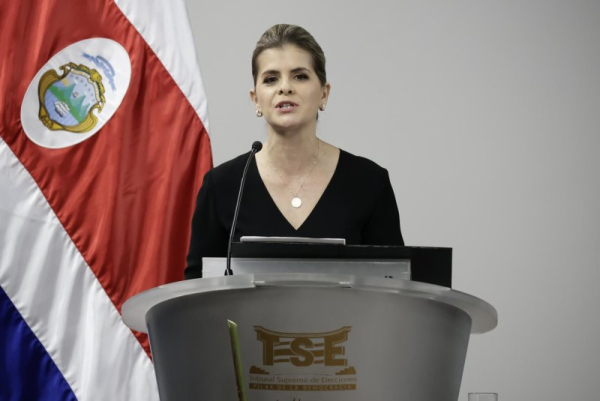
Costa Rican President Laura Fernandez speaks during the official credentials ceremony in San Jose, Costa Rica, on March 17. Costa Rica’s decision to downgrade relations with Cuba is more than a bilateral dispute — it also reflects a broader shift among some governments. Photo by Jeffrey Arguedas/EPA
Costa Rica’s decision to downgrade relations with Cuba is more than a bilateral dispute. It also reflects a broader shift among some governments in the Americas in how they weigh democratic principles against security concerns and geopolitical alignment.
The decision
On March 18, the government of President Rodrigo Chaves Robles announced the closure of Costa Rica’s embassy in Havana and the reduction of ties with Cuba to a strictly consular level. San José, Costa Rica’s capital, said Cuban diplomats would have to leave by the end of March, while future consular matters would be handled through Costa Rica’s embassy in Panama.
Foreign Minister Arnoldo André Tinoco informed Cuban Foreign Minister Bruno Rodríguez of the decision and later formalized it through diplomatic channels. Costa Rica also said its embassy in Havana had already been without diplomatic staff since early February.
The government justified the move by citing what it called irreconcilable differences over democracy and basic freedoms. President-elect Laura Fernández supported the decision and pointed to the continued deterioration of human rights conditions on the island. Cuba, in turn, said the measure reflected pressure from the administration of U.S. President Donald Trump. Costa Rica rejected that claim and said the decision was fully its own.
A break with tradition
The immediate argument inside Costa Rica is whether the move was wise and whether it could carry diplomatic costs. The bigger question is what it says about the country’s foreign policy.
For many years, Costa Rica tried to project moderation and a respect for dialogue through multilateral channels. Even when governments in San José disagreed with Havana’s political system, they often preferred engagement to rupture. That was the logic behind the restoration of diplomatic relations in 2009 under President Óscar Arias Sánchez, nearly five decades after Costa Rica severed ties with Cuba in 1961. The new decision marks the sharpest break since that restoration.
Seen narrowly, the practical costs are limited. Costa Rica does not rely heavily on Cuba economically or strategically. That makes the rupture easier to defend at home.
But foreign policy decisions are rarely read only in bilateral terms. Other governments tend to treat them as signals about priorities and alignment. That is why Costa Rica’s move matters beyond Havana.
Shifting weights
The regional setting has also changed. Across the hemisphere, security concerns, migration pressures, democratic backsliding, and rivalry among larger powers are pushing governments to define their positions more clearly.
In that environment, Costa Rica appears to be moving toward a foreign policy that gives more weight to democratic standards and political alignment with the United States than to the older instinct for caution and balance.
This does not mean Costa Rica is abandoning multilateralism. It does suggest, however, that values and strategy now carry more weight in San José than they did during earlier periods when pragmatism often came first.
Washington is likely to see the move as favorable. The United States is Costa Rica’s leading economic partner by a wide margin. According to the U.S. Trade Representative, two-way goods and services trade between the two countries totaled nearly $29.5 billion in 2024. The United States is also Costa Rica’s top export market and its main supplier of imports.
The security relationship also matters. Costa Rica and the United States work closely on drug trafficking and transnational crime, cooperation that was on prominent display at the Shield of the Americas summit in Florida earlier this month – the inaugural gathering of a 17-nation hemispheric coalition organized by the Trump administration to coordinate action against cartels and criminal networks.
Costa Rican leaders may well calculate that a tougher stance toward Havana strengthens San José’s profile with Washington at a time when such coordination is becoming more visible.
The reaction elsewhere may be less positive. Cuba still carries political weight in parts of Latin America and in diplomatic spaces where many governments remain wary of isolating Havana. It also now holds BRICS partner-country status, approved at the Kazan summit in October 2024 and in effect since Jan. 1, 2025.
For governments that favor a more multipolar international order, Costa Rica’s decision may look less like a defense of democratic principles than a gesture of alignment with Washington, one that could narrow room for maneuver in regional and global forums.
The consistency test
At the same time, Costa Rica’s decision may resonate with governments and political sectors that have grown more skeptical of engagement with authoritarian systems. For them, the break with Cuba is not an overreaction. It is a way of saying that democratic language should carry consequences.
Diplomatic breaks can send a strong signal, but they become doctrine only when applied consistently. If Costa Rica wants this step to be seen as part of a values-based foreign policy, it will eventually have to show that the same standards apply in cases beyond Cuba.
For now, the signal is clear enough. Costa Rica is redefining how it wants to be seen in the hemisphere, weighing democratic values and alignment with the United States more heavily than regional caution and traditional ties. Whether that choice is ultimately read as a principle or a positioning will depend largely on what San José does next.
Óscar Álvarez Araya is a political scientist and former Costa Rican ambassador to Taiwan. The views and opinions expressed in this commentary are solely those of the author.
