
How to “out-narrative” the CRInK — China, Russia, Iran and North Korea.

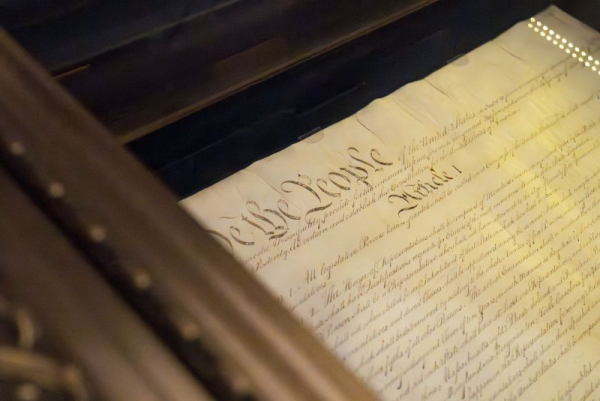
The U.S. Constitution sits on display at the National Archives in Washington, File Photo by Bonnie Cash/UPI | License Photo
The author prefers to use the lowercase “n” to challenge the Kim family regime’s legitimacy.
I recently attended the 3d Annual National Center for Narrative intelligence Summit at Ole Miss in Oxford, Miss. These thoughts were inspired by so many outstanding speakers and discussions both formal and informal. I believe we have to outcompete the authoritarian axis of the CRInK–China, Russia, Iran and north Korea by projecting the superior American narrative.
Some will criticize this narrative as naïve wishful thinking and unsupportable in the climate of today’s divisive American political environment. That may be so, but I will stand by our American values.
Paradox of control
The United States faces a hard truth. It cannot out-control authoritarian narratives without becoming something it is not. The strength of the American system rests on consent, law, and the freedom to speak. When government attempts to centralize or script a national narrative, it cuts against the grain of the Constitution and weakens its own legitimacy.
The paradox is clear. The American narrative is strongest when it is not controlled. The absence of central control is itself the signal. It shows confidence in the people and in the system.
Authoritarian regimes pursue coherence through command. They align words with power and punish deviation. This produces a clean message, but a brittle one. The United States produces a different effect. It generates a chorus. The voices are not always aligned, yet they rest on shared principles. That difference is not a flaw. It is the feature that adversaries cannot replicate.
Legitimacy as strategic center of gravity
If legitimacy is the center of gravity, then narrative must reinforce it. Legitimacy in the American context flows from fidelity to constitutional values — free speech, rule of law, civilian control. Individual rights. These are not slogans. They are operating principles.
Attempts to control narrative from the center create a gap between word and deed. Audiences at home and abroad see the gap. They draw conclusions. The result is a loss of trust that no information campaign can repair. In contrast, when officials speak with autonomy grounded in shared values, the message aligns with the system. It is consistent with how the nation behaves.
This approach accepts friction. It accepts that disagreement will be visible. Yet, that visible disagreement is proof of life in a free system. It is evidence that the state does not fear its citizens. That evidence carries weight in contested spaces where credibility is scarce.
Uncontrolled narrative as method
The uncontrolled narrative is not chaos. It is disciplined decentralization. It requires a clear foundation and a shared understanding of purpose. It demands that officials at every level know what the nation stands for and why it acts. It is derived from the oath all officials take and all Americans believe: “to support and defend the Constitution of the United States.” Our loyalty rests is to the belief in the idea of America.
The method has three parts.
First, educate. Officials must understand operate from American founding principles and how they apply in modern contexts. They must be able to explain policy in terms of rights, law, and mutual respect.
Second, empower. Once trained, officials must be trusted to speak within their remit. They should not wait for a script. They should act with judgment.
Third, connect. Communication must be tailored to the audience. It must reflect local context without abandoning core values.
This is not message discipline in the narrow sense. It is value discipline. The guardrails are principles, not talking points. The result is a narrative that is varied in voice, yet consistent in substance.
Superior narrative warfare
The United States should reject the idea of counter narrative warfare as a primary mode. Chasing adversary claims on their terms concedes initiative. It places U.S. communicators in a reactive posture. It invites escalation in a domain where speed favors the least constrained actor.
Superior narrative warfare begins elsewhere. It starts with framing issues through American values. It answers the question, “What does this action say about who we are?” It then communicates that answer across channels and levels, without waiting for central approval.
This approach does not preach. It does not project values as an export product. It speaks from values as a lived reality. When U.S. forces operate under law, when leaders accept scrutiny, when errors are acknowledged, the narrative is carried by action. Words then reinforce what audiences can already observe.
Consider the contrast. An authoritarian system may deliver a unified message about stability. The United States can demonstrate stability through lawful process, open debate and accountable power. The narrative writes itself because the behavior is visible.
Training for values-based communication
Freedom without preparation invites error. The uncontrolled narrative requires rigorous education. Officials must be trained to translate principles into clear language. They must understand how rights and law shape policy choices. They must learn to speak plainly.
Training should include history, both American and local. It should cover cultural norms, religious context and social dynamics in the regions where government officials, diplomats and military personnel operate. It should develop the skill to listen before speaking. It should teach how to frame complex issues without jargon.
There must also be instruction in risk — what can be said, what must be protected, how to handle uncertainty, how to correct mistakes in public. This is professional competence, not improvisation.
The goal is not uniformity. It is competence anchored in values. An officer in the field, a diplomat at a post, a civil servant in a capital all should be able to explain U.S. actions in terms that make sense to their audience and remain true to American principles.
Knowing the audience
Narrative does not exist in a vacuum. It lands in a cultural space. Officials must know that space. They must understand how history shapes perception. They must recognize grievances and aspirations. They must respect local customs.
This knowledge does not dilute American values. It sharpens their application. It allows the communicator to choose examples that resonate. It prevents missteps that can undermine trust. It turns communication into engagement rather than broadcast.
In restive environments, where trust is thin and rumor is strong, this matters most. A message grounded in respect and knowledge can open doors that a generic script will close.
Risks and counterarguments
Critics will argue that an uncontrolled narrative invites inconsistency. They will point to the risk of mixed messages and public error. They will note that adversaries exploit contradiction.
These concerns are real. They require mitigation, not abandonment of the approach. The mitigation is strong education, clear values and professional accountability. It is not central scripting.
There is also a concern about speed. Central control promises rapid alignment. In practice, it often slows response and produces sterile language. Decentralized communication can be faster and more adaptive, if the foundation is sound.
Another argument holds that values-based communication is naive in a contest with actors who lie without cost. The answer is not to mirror those tactics. It is to build a reputation that makes truth credible. Over time, credibility compounds. It becomes a strategic asset.
Policy implications
To employ the American uncontrolled narrative, institutions must adjust. They should shift from message approval to values certification. They should invest in education and regional expertise. They should reward judgment and integrity in communication.
They also should align action with words. Narrative cannot compensate for policy that contradicts stated values. The most effective communication is conduct. Leaders must ensure that operations, diplomacy and domestic practice reflect the principles they claim.
Finally, they should accept transparency as a condition of legitimacy. Errors will occur. When they do, acknowledgment and correction strengthen the narrative. Concealment weakens it.
Conclusion
The United States cannot win a contest of narratives by imitating systems that control speech. It wins by being what it claims to be. The uncontrolled narrative is not a vulnerability. It is a strategic advantage when anchored in constitutional values and professional competence.
Officials must be trained, trusted and empowered to speak from that foundation. They must know their audiences and respect their context. They must act in ways that make their words credible.
The choice is stark. Control the narrative and erode legitimacy, or trust the system and let legitimacy speak. Which path better serves national security in a long contest where belief matters as much as power?
David Maxwell, executive director of the Korea Regional Review, is a retired U.S. Army Special Forces colonel who has spent more than 30 years in the Asia-Indo-Pacific region. He specializes in Northeast Asian security affairs and irregular, unconventional and political warfare. He is vice president of the Center for Asia Pacific Strategy and a senior fellow at the Global Peace Foundation, where he works on a free and unified Korea. After he retired, he became associate director of the Security Studies Program at Georgetown University. He is on the board of directors of the Committee for Human Rights in North Korea and the OSS Society and is the editor at large for the Small Wars Journal.
