
Based on analysis by R. Evan Ellis, published in Strategic Insights by the U.S. Army War College Strategic Studies Institute


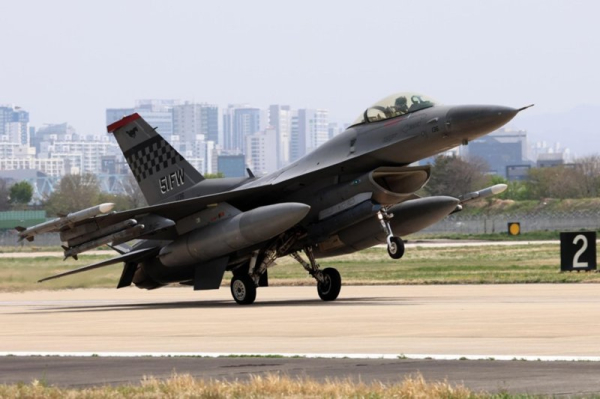
Peru’s decision to move forward with the purchase of U.S.-made F-16 fighter aircraft is more than a military procurement story. File Photo by Yonhap/EPA
Peru’s decision to move forward with the purchase of U.S.-made F-16 fighter aircraft is more than a military procurement story. It is a reminder that defense relationships in Latin America are shaped not only by price and equipment, but by politics, trust and strategic consistency.
The controversy surrounding the $3.42 billion sale shows how quickly a long-planned defense decision can become vulnerable to domestic political calculations. It also illustrates a larger challenge for Washington. In a region where China, Russia and other extra-regional actors are expanding their presence, U.S. access and influence depend on more than offering capable platforms. They depend on sustaining relationships across political transitions.
More than an aircraft purchase
Peru’s armed forces have a legitimate need to modernize. Its current fighter fleet includes aging aircraft from different origins, including Russian MiG-29s and French Mirage 2000s. Maintaining such a mixed fleet grows more difficult over time, especially as older systems become more costly to operate and harder to support.
The F-16 C/D Block 70, 24 of which Peru agreed to purchase from Lockheed Martin, would give the country greater capability while linking its air force to U.S. training and operational standards for decades.
That point is often missed in public debates over arms purchases. A fighter aircraft is not just a product delivered in a box. It comes with a long-term relationship. Pilots must be trained. Maintenance crews must be prepared. Spare parts, software and upgrades become part of a continuing network of cooperation, along with doctrine and joint exercises.
For the supplier country, that network creates access and influence. For the buyer, it creates dependence, but also reliability if the relationship is well managed. In practical terms, it can affect how countries cooperate on regional security, disaster response, counternarcotics and crisis management.
That is why Peru’s F-16 decision matters beyond Lima. In January 2026, the United States designated Peru a major non-NATO ally, recognizing its role as a serious defense partner. The F-16 deal was a natural next step in that relationship.
Politics enters the deal
The dispute began when interim President José María Balcázar sought to delay the purchase until the next government took office. His stated argument was that a transitional administration should not bind the country to such a large financial commitment. Peru held a presidential first round on April 12, with a runoff between leftist Roberto Sánchez and rightist Keiko Fujimori scheduled for June 7.
On the surface, that argument is not unreasonable. Major defense purchases deserve scrutiny, especially in countries where public resources are limited and political legitimacy is fragile. Peru has suffered repeated political crises in recent years, cycling through presidents at a pace that has weakened confidence in national institutions.
But the deeper concern was not merely procedural. Sánchez, a leftist candidate who has expressed sympathy for Cuba, finished second in the April 12 vote and could yet become Peru’s next president. By delaying the signing, Balcázar may have been trying to leave open the possibility that an incoming government could redirect the acquisition toward China or Russia, avoiding the long-term U.S. training, maintenance and intelligence relationships that accompany such a purchase.
U.S. Ambassador Bernie Navarro responded publicly and forcefully. Peru’s defense and foreign ministers resigned in protest over Balcázar’s intervention. Congress moved to censure him. In the end, the government signed the deal and made the $462 million initial payment, but the episode had already sent signals to competitors and raised questions about Peru’s reliability as a defense partner.
Openings for strategic rivals
China has substantially expanded its footprint in Peru, including through the Chancay deep-water port and telecommunications infrastructure. Russia has long had ties to parts of Latin America’s defense sector through arms sales and equipment support.
Neither Beijing nor Moscow needs to displace the United States everywhere to reduce U.S. influence. They only need openings where political hesitation, distrust of Washington or short-term domestic calculations make alternatives more attractive.
Such maneuvering is not new in Peru. Pro-Russian elements within the country’s military reportedly helped scuttle a 2016 U.S. offer of Stryker armored vehicles, redirecting a key modernization program away from Washington. The pattern is familiar. In defense procurement, delay is rarely neutral. It changes the political landscape in which decisions are made.
The deeper concern is not which aircraft Peru flies. It is whether the United States can remain a credible defense partner in a region where its rivals are patient, persistent and willing to exploit political openings to expand their leverage.
A defense ecosystem
A country that buys U.S. fighters is not simply purchasing aircraft. It is choosing a defense ecosystem that shapes training, intelligence sharing and logistics over decades. It determines how officers think, how forces train and how governments coordinate during crises.
That is why U.S. defense engagement in Latin America cannot be episodic. It must be steady enough to survive electoral cycles and shifting political winds.
The United States has real advantages: advanced technology, democratic legitimacy and deep institutional ties with many Latin American armed forces. But those advantages erode when engagement is inconsistent or when partner governments doubt whether Washington will remain present after the headlines fade.
The lesson for Washington
The lesson from Peru is not that Washington should pressure countries into buying U.S. equipment. Sovereign governments make their own decisions. But the United States must treat defense cooperation as a long-term strategic relationship, not a transaction completed upon contract signing.
That requires political attention as much as technical competence. U.S. officials must understand domestic debates in partner countries, explain the value of cooperation in terms beyond aircraft specifications, and show that working with the United States delivers dependable support and respect for sovereignty beyond the initial purchase.
Peru’s fighter jet dispute may soon pass from the headlines. The strategic lesson should not.
Gustavo Nakamura is Regional Director in Peru for CEFAS CEU (Ibero-American Center for University Studies), where he focuses on geopolitical analysis and institutional development in Latin America. The views expressed are solely those of the author.
