


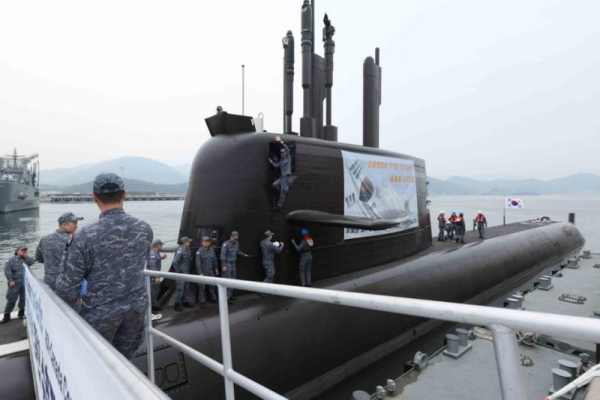
A plan to build Korean nuclear-powered submarines in the United States appears stalled. Photo by Yonhap/EPA
More than six months have passed since South Korea and the United States agreed in principle to pursue a nuclear-powered submarine program, yet follow-up negotiations have never begun.
The concept was placed on the table; the starting gun was never fired. The suspicion that this initiative may be quietly dying grows harder to dismiss.
Recent developments have deepened those doubts. When President Donald Trump authorized South Korea’s nuclear-powered submarine program Oct. 29, he announced on social media that the vessels would be built at Philly Shipyard — the facility he singled out as “great.”
Since then, Hanwha Philly Shipyard posted operating losses of 48.1 billion won, or about $33 million, in the first quarter, with deficits widening. One may legitimately ask whether a shipyard hemorrhaging money — the very yard Trump personally tasked with this historic mission — can sustain so vast and technically demanding an undertaking.
Those doubts were compounded by the Korea-U.S. defense ministers’ meeting at the Pentagon on May 11 — the first encounter between Defense Secretary Pete Hegseth and Defense Minister Ahn Gyu-back since Trump’s submarine authorization.
Expectations were high, and South Korea’s Defense Ministry had anticipated that possibility. Yet, the joint statement afterward contained no reference to nuclear submarines.
South Korean media described the meeting as two sides talking past each other: Seoul pressed “South Korea-led peninsula defense,” while Washington focused on burden-sharing.
Two ostensibly close allies conducted themselves as though facing each other across an adversarial table, making a once-unthinkable conclusion increasingly difficult to avoid: The nuclear submarine program may simply be off the table.
The meeting was convened hastily, just one day before the Korea-U.S. Integrated Defense Dialogue began, itself a signal that difficult security exchanges lay ahead. The outcome was a failure to build upon the most significant achievement of last October’s Korea-U.S. summit in Gyeongju, whose joint fact sheet had pledged cooperation on nuclear submarine construction.
A U.S. inter-agency negotiating team was scheduled to visit South Korea early this year to discuss the program alongside expanded enrichment and reprocessing rights and broader shipbuilding cooperation. Not a single formal session has taken place. South Korea’s nuclear submarine task force has made several trips to Washington, but these were preliminary contacts, not for substantive talks.
Why has it come to this? When Trump authorized the program, he declared the Korea-U.S. alliance “stronger than ever before.” Tracing the cause is the only way to recover what has been lost.
South Korean media have attributed the silence on submarines to delays in Korean investment in the United States and Seoul’s regulatory investigation of Coupang, the U.S.-listed Korean e-commerce company.
These are factors. Yet, both tensions predated Trump’s October authorization and did not prevent it, which suggests they are insufficient to explain why negotiations have frozen since. A more consequential explanation may be going unexamined: the strain between Seoul and Washington over the war with Iran.
Won Gon Park, a professor in the Department of North Korean Studies at Ewha Womans University, lends weight to this reading. In a published interview, he observed that the meeting took place “amid a situation in which U.S. demands are numerous, including participation in the Maritime Freedom Construct,” and predicted Seoul was “more likely to be handed homework than to press for what it wants” — submarines included.
That prediction proved accurate. It is reasonable to assume Washington pressed hard for South Korean participation in the Maritime Freedom Construct, the U.S.-led framework aimed at restoring freedom of navigation through the Strait of Hormuz, of which Hegseth has been among the most vocal advocates since a South Korean cargo vessel, the HMM Namu, was struck and crew members killed near the strait.
Seoul appears to have focused the meeting on wartime operational control transfer, making it plausible that Washington deliberately sidestepped the submarine question. The underlying logic is not difficult to read: Trump’s October authorization followed concrete Korean economic commitments made at Gyeongju.
That same transactional logic now operates in reverse. Washington appears to be signaling that further cooperation on sensitive defense technology requires visible Korean contribution to shared security burdens.
The Maritime Freedom Construct is not a formal military alliance, nor does it demand the troop deployments South Korea was pressed for during the Iran conflict. But it requires a posture close to that of a military partner: sharing intelligence, coordinating diplomatic pressure and contributing meaningfully to freedom of passage.
Seoul is understood to be keeping participation open, weighing it against international law, alliance obligations and the security environment. That caution may already have exacted a price.
The contrast with South Korea’s posture toward the European-led initiative is striking. Even as trade tensions with Washington persist, including over tariffs on EU-made automobiles, Seoul has actively participated in the British- and French-led multinational effort.
President Lee Jae Myung joined the video summit co-chaired by French President Emmanuel Macron and British Prime Minister Keir Starmer on April 17, pledging “a practical contribution to guaranteeing freedom of navigation through the strait,” and South Korean military officers joined a general-officer-level video conference led by Britain and France on April 30.
Seoul appears to calculate that a European-led, diplomatically framed initiative carries lower political risk than formal alignment with a U.S.-led framework. That calculation may be defensible, but it is not cost-free — and Washington is watching.
The question carries particular weight because South Korea is not a detached observer. Its vessel was struck in the Hormuz strait, making freedom of navigation not a matter of diplomatic abstraction, but of national experience.
And yet, Seoul has still not formally identified the party responsible for the attack or assigned accountability. There are conditions any responsible government must weigh. But the charge of excessive hesitation is one South Korea will struggle to escape, particularly in Washington’s eyes.
One need only recall what it took to arrive at this threshold. For more than 30 years — from the Kim Young-sam administration through to the Lee Jae Myung government — South Korea has pursued nuclear-powered submarines with singular persistence, beginning in 1993.
The Roh Moo-hyun government moved toward construction, only to abandon it amid funding shortfalls and a lack of technical expertise. The Moon Jae-in government revived the idea, only to see it collapse without U.S. cooperation. After three decades, approval finally came — and now six months of irreplaceable time are being squandered while the alliance frays.
Where can the missing talks be found? Recovery begins with South Korea setting aside its excessive caution in the face of Washington’s urgent requests. If Seoul is perceived as free-riding on U.S. security commitments while hedging on American-led coalitions, the political basis for Washington’s submarine authorization erodes.
The alliance does not operate on goodwill alone. If Seoul moves first and decisively, ideally ahead of any other partner, Washington will have every reason to return to the negotiating table.
Nohsok Choi is the former chief editor of the Kyunghyang Shinmun and former Paris correspondent. He serves as president of the Kyunghyang Shinmun Alumni Association, president of the Korean Media & Culture Forum and CEO of the YouTube channel One World TV. The views expressed in this commentary are his own.
