


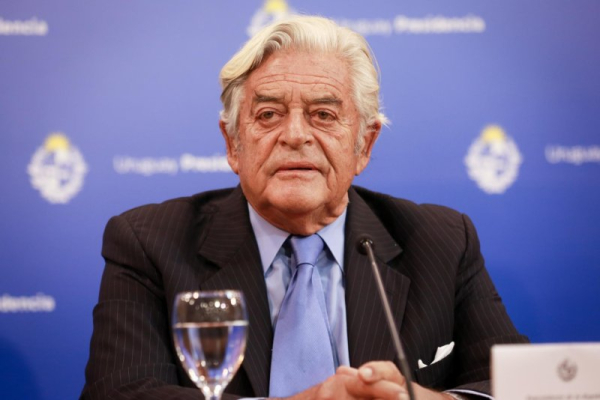
The former president of Uruguay, Luis Alberto Lacalle de Herrera, participates in a June 2023 press conference. File Photo by Alex Gutiérrez Páez/EPA
On May 31, Colombian voters will go to the polls to choose a new president from a field spanning the full ideological spectrum. In the weeks leading up to the vote, many young Colombians have followed and joined the campaign through social media, posting arguments and helping mobilize opinion online. Their energy is real. But watching this from afar, I find myself wanting to offer them a word of caution.
Across our hemisphere, this electoral season is giving reason for hope. Several countries are renewing their democratic commitments, and young people are more engaged in public debate than at any time I can remember. That engagement, however, takes a form that concerns me as much as it encourages me.
The digital world has drawn many young people into public life. That is genuinely good. But there is a large difference between participating in public opinion and participating in the concrete political life of a nation.
Social media spreads ideas and helps form opinions. It can gather support and provoke discussion. All of this matters. But it remains outside the actual system of government unless it is joined to real political action.
Every democracy functions through a constitutional framework. That framework varies by country, with different parties, election rules and voting schedules. But every democracy shares one requirement: citizens must work within it to exercise real power. Social media is one instrument of civic life. The ballot box and party organization are others. They are not interchangeable.
A social media post can reach thousands of people within minutes. That is a kind of influence. But in political life, influence over government requires something more patient: joining a party, understanding its internal processes, learning when elections are held and what is actually at stake in each. There is no instant result. There is no algorithmic shortcut. One must wait for the right moment, prepare for it and then act within the system.
That waiting is not a flaw in democratic governance. It is its nature.
One of the essential conditions for effective political participation is knowing the reality in which one intends to act. Theory is not enough, however sound the theory. Even a thorough understanding of democratic philosophy or constitutional law is only half of what is needed. The other half is reality: the lived circumstances of the people whose votes one seeks.
Reality is the raw material of politics.
Why? Because votes are won through proposals, and proposals must be grounded in what people actually face. A young leader who goes to a city neighborhood, a rural community or a factory floor and listens before speaking is doing political work of the highest order. That person is learning what people want: better employment, better wages, better health care, better schools, public order, and personal security.
These are not complicated desires. The great challenge of political life is not to identify them. It is to show, credibly, how they can be addressed.
That is where patience and skill become indispensable. A responsible political leader listens, interprets what has been heard and then explains, in the proper civic forums, what can actually be done to improve people’s circumstances. And this last phrase matters: what can actually be done. Politics is not a performance of perfect worlds. It is the difficult craft of the possible.
Citizens are perceptive. They can distinguish a realistic proposal from an impossible promise. They recognize the difference between a candidate who tells the truth about what government can do and one who claims to solve every problem overnight. Proposals grounded in reality will build more durable support than exaggerated propaganda — from presidential campaigns down to the smallest local election.
For young people, there is a path into public life. Politics has its own ladder. One must enter it, accept its rules and seek to rise within it. Advancement will come when people say: this young person knows our problems; she has been in our schools and workplaces; he knows what is happening, and what they propose is true and possible.
The impossible may sound beautiful. But it is false. And falsehood corrodes the democratic system.
This is why it matters to distinguish between the fast, vivid life of social media and the slower life of democratic power. Expressing ideas is one thing. Holding a position from which one can change reality is another. To change reality through public office, one must act with knowledge and respect for each country’s constitutional framework.
I encourage young people to use social media and spread ideas widely. Diffusion matters. But after that, they must enter their country’s constitutional system. Otherwise, they remain commentators — people in a café sharing opinions without transforming them into action.
If ideas are not brought into the system through which power is obtained and exercised, one remains only halfway along the road.
Young citizens should study when elections are held and which political party best reflects their convictions. No party will be a perfect match. But one should choose the closest available option, enter the system and seek popular support, which is the foundation of healthy democratic life.
Many organizations influence public life, including unions, civic associations, professional bodies, and religious institutions. These are all worthy forms of engagement. But there is one field that directly transforms society through binding rules: the political field. Political institutions can enact the laws and regulations that shape how people live.
That is why politics matters. Those who wish to change reality cannot remain in the world of opinion alone. They must enter the democratic system, listen to the people, make honest proposals and work patiently to turn conviction into public action.
As Colombia prepares to vote, I hope its young citizens, and young people across our hemisphere, will carry their energy from the screen into the system. That is where the real work begins.
Luis Alberto Lacalle de Herrera served as president of Uruguay from 1990 to 1995. A lawyer and longtime leader of Uruguay’s National Party, he also served as a national representative and senator. He is a founding member of the Latin America & Caribbean Presidential Mission and a regular contributor to Legacy of the Americas. The views expressed here are his own.
