


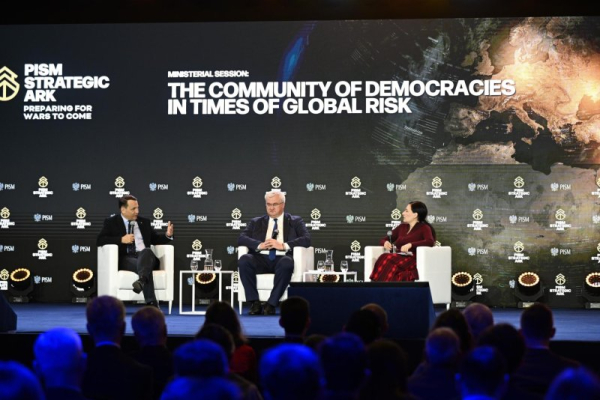
Polish Foreign Minister Radoslaw Sikorski (L), Ukraine’s Foreign Minister Andrii Sybiha (C) and moderator Sharon Weinberger (R) attend the 5th edition of the Polish Institute of International Affairs Strategic Ark conference in Warsaw, Poland, on May 12. The two-day conference was titled “Preparing for Wars to Come.” Photo by Radek Pietruszka/EPA
Earlier this month, the Polish Institute of International Affairs held a geopolitical forum in Warsaw with a title as provocative as it was revealing: “Preparing for the Wars to Come.”
The phrase captured the mood of the moment. When one of Europe’s most serious geopolitical conversations is framed around future wars, it suggests that humanity is entering a period of deep uncertainty. The discussions also made clear that the world is not simply witnessing another round of competition among great powers. It is experiencing a broader transformation of the international order.
I had the honor of participating as the only representative from Central America. That responsibility sharpened my attention not only to what was being said, but also to what was missing.
For too long, major global conversations have been shaped mainly by Washington, Brussels, Moscow or Beijing. Regions such as Central America have often been treated as territories of influence rather than as sources of ideas. Yet the world needs new historical experiences to navigate this era.
Central America has lived through ideological conflict, civil war and foreign intervention. It has endured fragile democracies and watched generations leave in search of opportunity. It has also learned, through hard experience, that no conflict can be sustainably resolved through military logic alone.
One concept that repeatedly emerged at the forum was “America First.” It is often understood as a political slogan, but it also reflects a broader global tendency: the retreat of nations into narrower definitions of self-interest.
I find the idea more compelling in the plural: “Americas First.”
That does not mean an America isolated from the world. It means an Americas conscious of its collective potential. It means a hemisphere that is not organized by domination or neglect, but by the possibility of building together.
The real problem is not that nations defend their interests. Every country does that. The danger begins when the world organizes itself only around competing formulas of national or regional advantage. “America First,” “China First,” “Europe First” and similar slogans may differ in language, but they share a common risk: each bloc seeks immediate advantage while global cooperation steadily weakens.
History teaches a different lesson. The reconstruction of Europe after World War II, the creation of the multilateral system and the expansion of public health cooperation all point to the same truth: progress depends more on cooperation than on isolation.
Latin America has its own lessons to offer. The Esquipulas Peace Agreements showed that even during the Cold War, when Central America became a stage for global ideological confrontation, it was still possible to choose dialogue and negotiation over permanent conflict.
The region understood then what remains urgent today: stability cannot be built by force alone. Peace requires democratic governance and real development.
That lesson matters because Central America is still too often viewed only through the lens of migration or security. Those challenges are real, but they do not define the region’s full importance.
Central America sits at the geographic heart of the hemisphere. It connects North and South America while linking the Atlantic and Pacific Oceans. It is close to the world’s largest consumer market and has significant potential in logistics, renewable energy, digital services and regional trade.
Its greatest strategic asset, however, may be its people. While many developed societies are aging rapidly, Central America remains young. Millions of young people should not be seen as a burden. They are a strategic resource if the region can transform demographic energy into education, innovation and real opportunity.
That is why the debate over migration cannot be reduced to borders or security. The deeper question is whether Central America can turn its demographic bonus into a development bonus.
The Western Hemisphere is once again attracting strategic attention. For years, political and economic spaces left unattended by the United States and Europe were increasingly occupied by other powers, particularly China. Geopolitical competition has returned to the Americas.
But the hemisphere should not respond by reviving old doctrines of control. The question for the 21st century is not simply who dominates. It is which powers help build the conditions for shared prosperity, democratic stability and human dignity.
Ports, supply chains, energy systems and digital networks are now part of the geopolitical map. But behind each of them stands a deeper question: What kind of future are we building, and for whom?
At a forum titled “Preparing for the Wars to Come,” it may sound unusual to speak of what I would call the Geopolitics of Love. Yet perhaps this is precisely the concept our age needs most.
Love, in this sense, is not sentimentality. It is not naïve idealism. It is the recognition that humanity is deeply interconnected.
The multilateral system is imperfect. It is often slow, bureaucratic and frustrating. But it was born from the conviction that dialogue is more durable than war and that shared responsibility is more productive than collective collapse.
That principle remains vital in an era marked by nuclear risk, climate pressure, forced migration, artificial intelligence and geopolitical fragmentation.
Poverty and polarization cannot be solved through permanent national selfishness. In geopolitical terms, love is not weakness. It is the strategic understanding that cooperation is no longer optional.
Perhaps the future will not belong to those who simply say “first.”
Perhaps it will belong to those who understand that no nation, and no region, truly goes far alone.
Olinda Salguero is a Guatemalan leader in regional integration and peacebuilding in Latin America. She served for four years as Chief of Staff to the Secretary-General of the Central American Integration System (SICA) and is the President of the Esquipulas Foundation for Peace, Democracy, Development and Integration. She collaborates with initiatives of both the Global Peace Foundation and the Latin American & Caribbean Presidential Mission. Forbes has recognized her three times as one of the most influential women in Central America. The views expressed are solely those of the author.
