

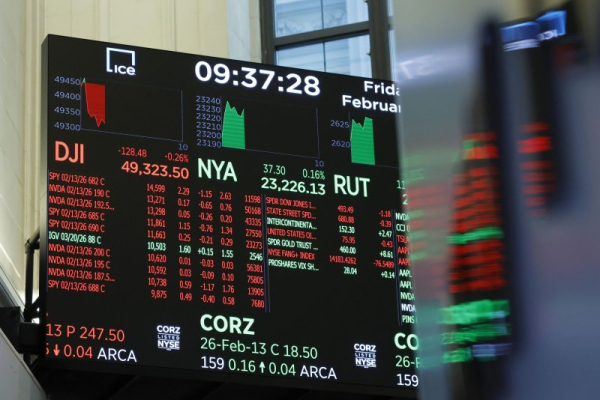
A board on the floor of the New York Stock Exchange shows the DOW down over 100 points after the opening bell on Wall Street on Friday in New York City. Photo by John Angelillo/UPI | License Photo
Part 6 of a series examining structural barriers to growth and competitiveness in Latin America.
In previous installments of this series, we examined how inflation functions as a hidden tax that makes money more expensive, and we broke down the components of equity, debt and the weighted average cost of capital (WACC).
We now turn to a decisive factor for international investors, including those in the United States, when evaluating opportunities across Latin America: political risk.
Expropriations, abrupt regulatory shifts, weak institutions and policy reversals do not merely create uncertainty. They directly increase a country’s risk premium. That premium feeds into the cost of capital, raising the minimum return investors require before committing funds. When that threshold rises too high, capital flows slow and in some cases stop altogether.
Why political risk directly affects U.S. capital
Consider a U.S.-based energy fund evaluating a $100 million oil exploration project in Latin America. Before assessing geology or production capacity, the fund must determine whether the expected return compensates for political and institutional risk.
To do this, analysts calculate the cost of capital: the minimum annual return required to satisfy both shareholders and lenders. This blends the cost of equity and the cost of debt into a single figure: the WACC.
In countries where institutions are stable and rules are predictable, that cost remains manageable. Interest payments are tax-deductible, legal frameworks are reliable, and contracts are generally enforced.
In politically volatile environments, however, these assumptions weaken. If tax regimes change abruptly, contracts are renegotiated or assets face the risk of nationalization, investors demand higher returns to compensate. Lenders raise interest rates. Equity investors require larger margins. The WACC rises accordingly.
As required returns increase, the present value of future cash flows declines. A project projected to generate $20 million annually over a decade may appear attractive in a stable setting. Under elevated political risk, the same project may no longer meet the required hurdle rate. The investment is postponed or redirected elsewhere, often to more predictable jurisdictions.
Another relevant factor is “beta,” a measure of how volatile an investment is relative to the broader market. Political turbulence increases perceived volatility, raising beta and pushing up the cost of equity. In practical terms, unpredictability makes U.S. capital more cautious and more expensive.
Venezuela: Resource wealth without investor confidence
Venezuela illustrates how political risk can severely restrict capital access.
Despite possessing some of the world’s largest proven oil reserves, the country’s sovereign credit standing has remained weak. High default spreads reflect investor doubts about repayment capacity and institutional reliability.
A prolonged period of expropriations, unilateral contract changes, and governance deterioration significantly increased the risk premium on Venezuelan projects. For U.S. and international investors alike, the cost of capital became prohibitive. Production declined, infrastructure deteriorated and a cycle of underinvestment reinforced itself.
Recent political developments and discussions regarding potential debt restructuring have prompted renewed market attention. However, unresolved legal disputes, large infrastructure needs and fragile institutional recovery continue to keep required elevated returns. Capital tends to return gradually and selectively, particularly when credibility must be rebuilt over time.
Venezuela’s experience underscores a fundamental point: abundant natural resources do not offset institutional risk.
Ecuador: Reform progress, but lingering uncertainty
Ecuador presents a more intermediate case.
Although its credit profile has been stronger than Venezuela’s, it remains below investment grade. Recent fiscal consolidation efforts and engagement with multilateral institutions have modestly improved investor perceptions. Government initiatives aimed at attracting private participation in hydrocarbons and mining signal a desire to stabilize and grow the economy.
Yet structural challenges persist. A national referendum halting development in the ITT oil block demonstrated how domestic political pressures can quickly reshape the investment climate. Security concerns linked to organized crime, as well as legislative fragmentation, contribute to investor caution.
For U.S. firms considering upstream opportunities, these factors translate into significantly higher financing thresholds than in more stable markets. Even with international financial support mechanisms in place, risk premiums remain elevated enough to constrain foreign direct investment.
Ecuador’s case shows that reform momentum can reduce risk, but consistency over time is what ultimately lowers financing costs.
Uruguay: Stability as a competitive advantage
Uruguay provides a contrasting example.
With solid sovereign ratings, institutional continuity and a reputation for judicial independence, Uruguay benefits from comparatively lower risk premiums. Investors, including U.S.-based funds, generally have greater confidence that contracts will be honored and that policy changes will follow established procedures.
As a result, the cost of capital for long-term projects tends to be lower than in many neighboring countries. This has supported sustained investment in renewable energy, agriculture and related sectors.
Uruguay’s experience demonstrates that institutional reliability functions as a competitive advantage in global capital markets. Predictability reduces risk, and reduced risk lowers financing costs.
Looking ahead: Institutions as economic strategy
Political risk is not an abstract concept. It is a measurable financial variable that directly influences whether capital is deployed or withheld.
For U.S. investors managing portfolios with global options, Latin America competes not only within the region but also with Asia, Europe and North America itself. Capital flows toward environments where returns are attractive relative to risk – and away from those where uncertainty dominates.
The contrast among Venezuela, Ecuador and Uruguay illustrates how institutional strength, regulatory continuity and contract enforcement shape those calculations. Where credibility is weak, the cost of capital rises and investment opportunities narrow. Where governance is stable, financing becomes more accessible and long-term development becomes more feasible.
For policymakers across Latin America, strengthening institutions is more than a governance objective. It is an economic growth strategy. Lowering political risk reduces the cost of capital, expands investment capacity and increases competitiveness in global markets.
In an era of shifting geopolitical and financial dynamics, the countries that provide reliability will attract the capital that fuels future growth.
César Addario Soljancic is an economist specializing in public finance, with decades of experience advising governments and institutions across Latin America and the Caribbean. Over his career, he has led 69 capital-market issuances across 13 countries, totaling nearly $49 billion. The views expressed are solely those of the author.
