

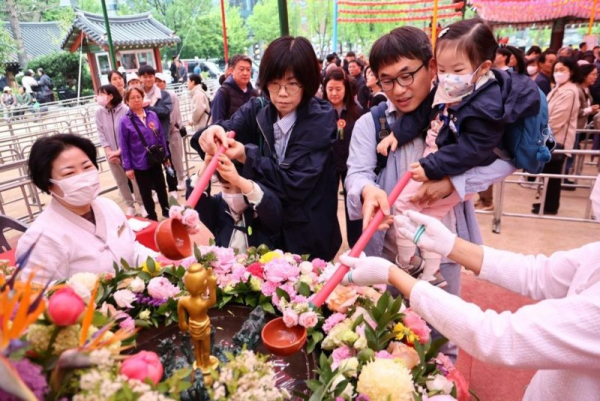
family of three performs the ritual of bathing a statue of baby Buddha during an event celebrating Buddha’s birthday at Jogye Temple in Seoul in May. Photo by Yonhap.
The author prefers to use the lowercase “n” to challenge the Kim family regime’s legitimacy.
Kim Jong Un’s declaration of “two hostile states” is not rhetorical theater. It is doctrine.
By embedding the concept in the Workers’ Party charter, the regime elevated it above ordinary policy and placed it inside the ideological constitution of the state. The removal of language about reunification, national unity and shared Korean identity signals a decisive break with decades of official narratives.
This move is not about diplomacy. It is about survival.
The Kim family regime understands that the most dangerous threat to its rule is not a military strike. It is legitimacy. A free and unified Korea offers an alternative political future for the Korean people. That idea alone undermines the foundation of the regime.
By declaring South Korea a hostile foreign state, Pyongyang attempts to erase the possibility that Koreans on both sides of the peninsula belong to one nation. If the people of the north cease to imagine a shared Korean future, the regime becomes the only political reality they can conceive.
The strategy is defensive. It is ideological armor against the power of freedom.
Implications for denuclearization
The “two state policy” also carries a strategic signal that cannot be ignored. If north Korea defines the Republic of Korea as a permanent hostile foreign state, then its nuclear arsenal becomes permanent, as well. Nuclear weapons become the guarantor of regime survival in a hostile international system.
This means the traditional diplomatic formula is now obsolete. Negotiating away the nuclear program through arms control diplomacy assumes the regime believes coexistence is possible.
Kim’s doctrine suggests the opposite. Coexistence with a free Korea is unacceptable. If this is true, then denuclearization cannot be the starting point of strategy. It must be the end state.
14-word strategy
The ROK/US alliance should adopt a clear strategic principle. Unification first, then denuclearization; the path to unification is through information and human rights.
This 14-word strategy reflects the political reality of the peninsula.
Denuclearization is impossible while the regime survives unchanged. But the regime cannot indefinitely withstand exposure to truth, outside information and the moral pressure of universal human rights.
Information weakens the ideological walls of the state. Human rights expose the regime’s illegitimacy. Together they reshape the political battlefield.
This approach does not seek immediate collapse. It seeks long term transformation. The struggle becomes political rather than purely military.
Human rights as a strategic center of gravity
Human rights must move to the front of alliance strategy.
For decades, the issue has been treated as a humanitarian concern separate from security policy. That division was always artificial. The regime’s brutality toward its own population is inseparable from its nuclear weapons program and its military aggression.
Repression is the mechanism that allows the regime to survive. A human rights first approach accomplishes three strategic goals.
First, it restores moral clarity. The conflict on the peninsula is not merely a geopolitical dispute. It is a struggle over the dignity and freedom of the Korean people.
Second, it shifts the narrative battlefield. When the world focuses on prison camps, forced labor and crimes against humanity, the regime loses its ability to present itself as a normal state.
Third, it empowers the north Korean people themselves. Information about human rights creates awareness that their suffering is neither invisible nor permanent.
In political warfare, legitimacy is decisive terrain.
Information as strategic power
Information is the most powerful non kinetic tool available to the alliance.
The north Korean system depends upon isolation. The regime maintains control by monopolizing truth. When outside information enters the country, the regime’s ideological control begins to erode.
Technology makes this increasingly difficult to prevent. Digital media, smuggled devices, cross border broadcasts and diaspora networks create channels that the regime cannot fully seal.
An alliance information strategy should therefore pursue several objectives.
First, expand access to outside media. South Korean culture, global news and Korean historical narratives remind people in the north that they belong to a broader civilization beyond the regime.
Second, highlight the reality of life in a free Korea. Prosperity, political participation and open society present a powerful contrast to the regime’s propaganda.
Third, reinforce the idea that the Korean nation remains one people.
Kim’s doctrine attempts to sever that identity. Information can restore it. Information can protect it.
Political warfare is ultimately a contest over imagination. If the people of the north begin to imagine a different future, the regime loses control of the narrative.
Alliance political warfare
Information alone is not enough. It must be integrated into a disciplined political warfare strategy.
Political warfare uses every instrument of national power to influence perceptions, legitimacy and political outcomes. In the case of the Korean Peninsula, the objective is clear: sustain the vision of a free and unified Korea, while exposing the illegitimacy of the regime that occupies the northern half of the peninsula.
The alliance should therefore pursue several lines of effort.
Diplomatic pressure should continue to highlight the regime’s violations of international law and human rights obligations.
Legal initiatives should reinforce accountability for crimes against humanity, as well as global illicit activities.
Economic measures should target the regime’s elite networks rather than the population.
Information campaigns should communicate directly to the north Korean people.
None of these actions alone will change the regime. Together they create cumulative pressure. Political warfare is a campaign measured in months, years and decades.
Solving the Korea question
The long term objective remains unchanged. It was stated clearly in paragraph 60 of the 1953 Armistice Agreement. The Korean conflict requires a political settlement that resolves the future of the peninsula.
The armistice froze the war. It did not solve the Korea question.
Kim’s “two hostile states” doctrine attempts to close that question permanently by declaring division irreversible. Yet, the regime does not possess the authority to decide the destiny of the Korean nation.
History suggests the opposite. Divided nations rarely remain divided forever. Germany reunited. Vietnam unified. The Soviet empire collapsed. Political systems that appear permanent often prove fragile once legitimacy erodes.
The Korean Peninsula will eventually face its own moment of transformation. The alliance must prepare for that moment.
Strategic error and strategic opportunity
Kim’s doctrine may contain the seeds of its own failure. By declaring South Korea permanently foreign, the regime reveals a profound insecurity. It admits that coexistence with freedom is impossible. That admission exposes the regime’s greatest fear a free Korea.
If the regime truly believed its system was legitimate and durable, it would not need to erase the idea of Korean unity. Ideological prohibitions are often signs of weakness.
The ROK/U.S. alliance should recognize this moment for what it is — not the end of the Korean national project, but the beginning of a new phase in the struggle for it.
The future of the peninsula will not be decided solely by missiles, sanctions, or summits. It will be decided in the minds of the Korean people.
Conclusion
Kim Jong Un’s “two hostile states” doctrine marks a turning point. It abandons the fiction that the regime will negotiate away its nuclear weapons in exchange for co-existence. The alliance must respond with equal clarity.
Denuclearization cannot be the starting point of strategy. It must be the result of political transformation on the peninsula. A new alliance strategy should therefore rest on a simple foundation: unification first, then denuclearization.
The path to unification is through information and human rights. This approach recognizes the central truth of the Korean question. The division of Korea is not merely a geopolitical problem. It is a political problem rooted in legitimacy.
And legitimacy, once lost, is almost impossible for a regime to recover.
If the regime’s greatest fear is the idea of a free Korea, should alliance strategy focus less on military deterrence alone and more on winning the contest of legitimacy?
If information is the most powerful non kinetic weapon on the peninsula, why does the alliance still treat it as a peripheral tool rather than a central instrument of national strategy?
And the largest question of all: If the Korean War never truly ended, what strategy will finally resolve the Korea question the armistice left unfinished?
The only way we are going to see an end to the nuclear program and military threats as well as the human rights abuses and crimes against humanity being committed against the Korean people living in the north is through achievement of unification.
This requires the establishment of a free and unified Korea. It must be secure and stable, non-nuclear, economically vibrant and unified under a liberal constitutional form of government based on individual liberty, rule of law and human rights as determined by the Korean people.
A free and unified Korea, or in short, a United Republic of Korea (U-ROK). (“You rock.”)
David Maxwell, executive director of the Korea Regional Review, is a retired U.S. Army Special Forces colonel who has spent more than 30 years in the Asia-Indo-Pacific region. He specializes in Northeast Asian security affairs and irregular, unconventional and political warfare. He is vice president of the Center for Asia Pacific Strategy and a senior fellow at the Global Peace Foundation, where he works on a free and unified Korea. After he retired, he became associate director of the Security Studies Program at Georgetown University. He is on the board of directors of the Committee for Human Rights in North Korea and the OSS Society and is the editor at large for the Small Wars Journal.
