
Watching Iran burn, Pyongyang’s dictator cannot sleep.

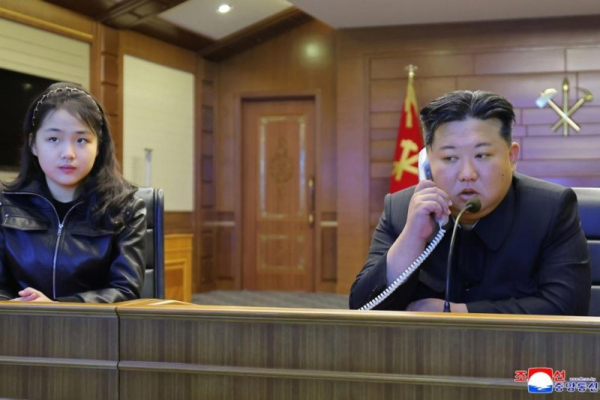
North Korean leader Kim Jong Un and his daughter, Kim Ju-ae, watch a live feed of a strategic cruise missile test-fire from the naval Destroyer Choe Hyon at an undisclosed location in North Korea on Tuesday. Photo by North Korean Central News Agency/EPA
Kim Jong Un cannot sleep. On Feb. 28, s U.S. precision strike brought down Iran’s supreme leader, Ayatollah Ali Khamenei. Since that day, images have been reaching Pyongyang — every day — of American and Israeli forces reducing Iran’s nuclear facilities, missile bases, air power, and naval forces to ash.
Not since the fall of Baghdad in 2003 has the world witnessed the military apparatus of a rogue state dismantled so thoroughly and so ruthlessly.
I do not know what Kim Jong Un had for breakfast. But what has been consuming his mind for the past two weeks — that I can state with absolute certainty: the cold, lifeless body of Khamenei; the sight of once-vaunted missile bases reduced to smoldering rubble; the spectacle of a theocratic regime that believed its deterrence was real, crumbling at the very moment that belief shattered.
And one message, seared into Kim Jong Un’s consciousness as he watches the flames rise: You are next. I know intimately how North Korea’s leadership reads the world in moments of crisis.
A mirror from which he cannot look away
Iran and North Korea were never merely ideological fellow travelers. They were strategic partners, sharing nuclear and missile technology for decades, conducting arms transfers and jointly operating networks to evade international sanctions. I witnessed this firsthand from inside Pyongyang.
Above all, the two countries stood on a common front against what they called American imperialism. Khamenei believed that nuclear capability and ballistic missile power were the ultimate insurance policy against the United States. He built his entire deterrence architecture upon that belief.
He was wrong. And Kim Jong Un watched him die for it.
The psychological impact of this on Kim cannot be overstated. Since my defection in October 2014, I have closely observed how the Kim regime processes external shocks.
When a lesson arrives from the outside world that strikes at the very foundation of the leadership’s survival logic, the response is never cool recalibration. It is fear — fear dressed in the language of anti-American resolve. That is precisely what is unfolding in Pyongyang right now.
15 days, five military moves
The timeline speaks for itself. On March 4 and 5, the fifth and sixth days after Khamenei’s death, Kim Jong Un personally oversaw cruise missile test-firings from the destroyer Choe Hyon.
Then, on Tuesday, he watched the same vessel launch another salvo of six cruise missiles, this time via video link. The compulsive repetition — same ship, same drill — reads as the behavior of a man gripped by fear.
On Wednesday, he brought his daughter, Kim Ju-ae, to a munitions factory that produces a new model handgun, personally stepping onto the firing range to pull the trigger. Senior military commanders and high-ranking Party officials fired alongside him.
This was no routine inspection. It had the unmistakable look of an anxious man performing confidence he does not possess — for the world and for his own people.
Then came Saturday, exactly 15 days after Khamenei fell. Kim Jong Un watched 12 600mm multiple rocket launchers strike targets in the East Sea 226 miles away, with what North Korean state media claimed was a 100% hit rate.
He called the weapon “terrifyingly attractive” and threatened that it would “cause anxiety among enemies within its 420-kilometer range.” The remark was almost certainly made with tactical nuclear warhead deployment in mind. That range encompasses Seoul, the greater metropolitan area of some 20 million people, and U.S. military installations at Pyeongtaek and Osan.
Five military events in 11 is not a strategic offensive. This is a man who cannot sit still.
Confession of a frightened leader
Listen again to what Kim said Saturday. He warned that if North Korea’s “defensive deterrence” failed to prevent foreign aggression, it would “immediately be converted into a massive destructive offensive weapon.”
This sounds like a strategic threat. It is, in fact, a confession of his nightmare. Heard in the context of what he has just witnessed in Iran, it sounds less like a warning and more like a scream.
Nuclear deterrence functions only when the adversary genuinely believes you will use it. Khamenei was obsessed with weapons development, and his conventional military forces and missile arsenal were, by any measure, several times more powerful than North Korea’s. It was not enough.
Kim may possess nuclear weapons, but if he is struck down like Khamenei, before he ever has the chance to use them, it is over. And who, after the decision-maker is dead, would press the nuclear button in his name?
North Korea is a grotesquely deformed decision-making system built around a single man. No one else can act in his place. There is no exit from this logic. Kim himself knows it better than anyone, for he trusts no one. This is the structural vulnerability of the North Korean system.
Perhaps this is why he brings his daughter everywhere, drilling into her the capacity to one day press that button. But Khamenei was killed together with his daughter, his son-in-law and his daughter-in-law.
The lesson he Is drawing — and why it Is wrong
Kim Jong Un appears to be drawing the conclusion that Iran’s failure is not a signal to reconsider his nuclear program, but proof that he must accelerate it. In his calculus, the only path to survival is more nuclear capability, acquired faster, at whatever cost.
That conclusion is understandable. But it is a trap — one that makes him a target. As Iran’s leadership has just demonstrated, that logic ends in catastrophe.
The 600mm multiple rocket launcher, capable of delivering a miniaturized nuclear warhead, is — as Kim himself said — a terrifyingly powerful weapon. But paradoxically, the most dangerous thing in North Korea today is not that weapon. It is the fear that has taken hold of the man who ordered it fired.
Before that fear drives him to a decision that cannot be undone, Washington, Seoul and Tokyo must find an answer — and they must find it now.
Ri Jong-ho is a former senior North Korean economic official who served under all three leaders of the Kim family regime. Beofre his defection, he served as China Branch Manager of Korea Daehung Trading General Corp., based in Dalian — a company operating under Office 39, the clandestine financial apparatus under the direct control of the ruling Kim family. Before his assignment in Dalian, he held a series of pivotal positions, including president of Korea Daehung Shipping Co. and general president of Korea Daehung Trading General Corp., a post equivalent to vice minister rank in the North Korean party-state. He was subsequently appointed by Kim Jong Il as chairman of Korea Kumgang Economic Development General Corp. under the National Defense Commission. Ri Jong-ho is a recipient of the Hero of Labor Award, the highest civilian honor bestowed by the North Korean state. After a series of brutal purges carried out by Kim Jong Un, he defected to South Korea with his family in late 2014. He resides in the greater Washington, D.C., area.
