

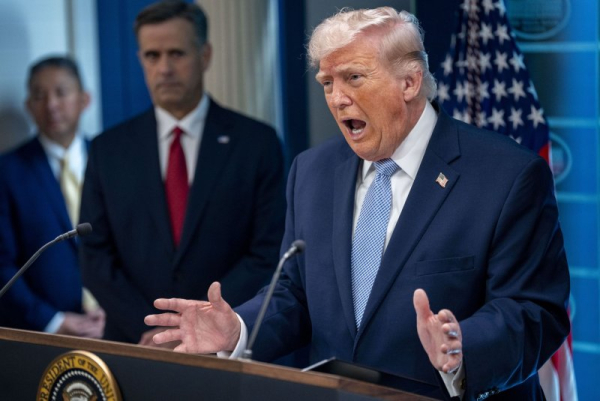
President Donald Trump speaks during a briefing on Iran in the James S. Brady Briefing Room at the White House in Washington on Monday. Photo by Bonnie Cash/UPI | License Photo
Two big caveats are an element of this column.
First, this column is purposely written before the Tuesday 8 p.m. EDT deadline issued by President Donald Trump for Iran, in essence, to surrender or face the prospect that “a whole civilization will die tonight.”
Second, for some reason, Trump constantly claims he has “decimated” Iran’s military and will do the same to its infrastructure. But does he understand the meaning of the word “decimate”? Clearly not.
Historically, decimate meant to reduce by one‑tenth. The term comes from Latin decimatus and referred to Rome’s punishment for mutiny, in which one in ten soldiers, chosen by lot, was executed by his comrades.
In modern usage, the word has drifted to mean “to destroy a large part of,” but its original sense underscores how imprecisely it is often used today.
And perhaps Trump is correct. Perhaps despite the 13,000 or so targets struck, only a small proportion of Iran’s total military arsenal has been decimated.
Trump has raised the ante by hitting military targets on Kharq Island as a warning to Tehran or possibly an indicator of things to come. About what he may or may not do, Trump has three options.
The first is to carry out the threat to destroy, not decimate, Iran’s power and transportation infrastructure, sending it back to the stone age. A variant could conceivably be the demonstrative use of a nuclear weapon to show intent. After all, if one is going to kill a whole civilization, why not do it with a very big bang?
Second, Trump could selectively target parts of the infrastructure as a signal to raise the pressure on Tehran to negotiate as a subset of a strategy to end the conflict short of societal annihilation. This would give time for diplomacy to take hold. And it would give Washington and Tehran incentives to stop the war.
Third, Trump could claim that threat worked. While Tehran may not have fully capitulated, it understands that its future behavior could risk the fire and fury Trump has promised. Despite the ridicule Trump would attract for yet another TACO display that Trump Always Chickens Out, he would declare victory and ignore the brickbats.
But, let’s assume Trump intends to carry out what he has threatened. The consequences, domestically and internationally, will be catastrophic. It is obvious that the death of a civilization in some circumstance would and should be considered a war crime. However Trump would have strong precedent to make his case for obliterating Iran as a functioning state.
During World War II, the allies firebombed many German and Japanese cities, eviscerating tens or hundreds of thousands of civilians in a night. Then, the United States dropped two atom bombs on Japan. No one claimed war crimes and the United States did not start it.
Similarly, the United States expended more ordnance on Southeast Asia during the many years of the Vietnam War than it did during World War II killing innocent civilians.
Trump would make use of these and other examples to justify his actions. His claim would be that unchecked, Iran would have built and used nuclear weapons against its neighbors, Israel and the United States. Thus, preemption was a vital national interest.
Would that stand the test of time? Proving Iran’s nuclear intent could suffer from earlier and fatally flawed reasons for going to war in Iraq and Vietnam. There were no weapons of mass destruction in Iraq, and the Gulf of Tonkin Resolution was passed on the basis of a second North Vietnamese PT boat attack against U.S. destroyers that never occurred.
Iran will retaliate against its neighbors. Gulf infrastructure would be subject to elimination. Not just petrochemical facilities would be hit. Desalination plants would be destroyed, creating a humanitarian nightmare. Oil could reach $200 a barrel.
Meanwhile, where is Congress? Will Congress allow Trump to destroy a civilization on his own? One wonders. And the military is caught in an impossible situation. Is ordering the destruction of a civilization legal? If so, under what conditions? If not, then what?
Of course, Trump could claim victory. We will learn later Wednesday or soon after whether this was bluff or bombing. As Churchill understood that “jaw, jaw was better than war, war.” But does Trump?
Harlan Ullman is UPI’s Arnaud deBorchgrave Distinguished Columnist, senior adviser at Washington’s Atlantic Council, chairman of a private company and principal author of the doctrine of shock and awe. His next book, co-written with Field Marshal The Lord David Richards, former U.K. chief of defense and due out later this year, is Who Thinks Best Wins: How Decisive Strategic Thinking Will Prevent Global Chaos. The writer can be reached on X @harlankullman.
