


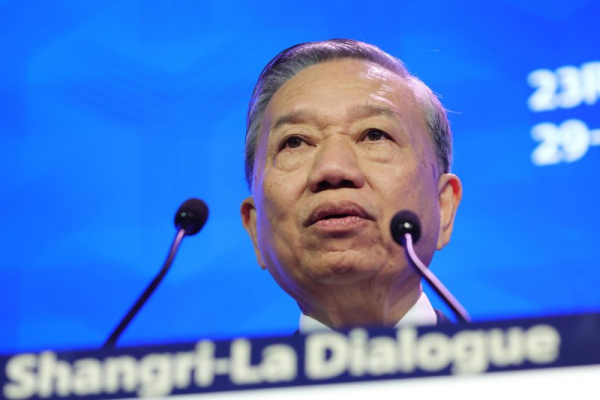
General Secretary of the Central Committee of the Communist Party and President of Vietnam To Lam delivers his speech during the opening of the International Institute for Strategic Studies Shangri-la Dialogue Defense Summit in Singapore on May 29. File Photo by How Hwee Young/EPA
On May 29, Vietnamese Communist Party General Secretary and President Tô Lâm delivered the keynote address at the IISS Shangri-La Dialogue in Singapore, becoming the first Vietnamese party chief to address Asia’s premier defense forum.
The speech was carefully calibrated to present Vietnam as a constructive regional actor committed to trust, cooperation and rules-based order, earning praise as a diplomatic success.
Tô Lâm organized his remarks around three converging crises: a crisis of development, a crisis of security, and a crisis of trust.
He warned against coercive power politics, called for a rules-based regional order, and argued that Asia requires not the dominance or exclusion of any single major power, but “responsible commitment” from all.
He called for confidence-building initiatives that connect not only governments and militaries but also scholars, businesses, and social organizations.
Several passages carried real analytical weight. On the foundations of durable security, Tô Lâm argued that “a society capable of discerning truth from falsehood, maintaining cohesion amid turbulence, and resisting manipulation by fear, hatred or distortion provides one of the strongest foundations for sustainable security.”
On regional order, he stated that it “cannot be built upon perpetual fear and mutual mistrust.” The language was not diplomatic boilerplate. They were substantive propositions, and international audiences treated them as such.
But genuine success at the podium creates an obligation that cannot be deferred indefinitely. When a leader stakes his country’s regional credibility on the language of trust, transparency, and a rules-based order, that language becomes a benchmark.
It sets a standard not only for how Vietnam engages its neighbors, but for how Vietnam governs at home. The harder question is not whether Tô Lâm meant what he said. It is whether the system he leads is prepared to sustain in practice the standards it now articulates abroad.
Fear and trust as a political test
The most revealing passage in the address is its framing of fear. Tô Lâm argued that sustainable security depends on political communities that are not governed by fear and distrust. The argument was directed at the international system.
But the logic does not stop there. If fear corrodes the capacity for trust between states, it also corrodes the capacity for trust within them.
A state confident in its own legitimacy should be able to sustain a diverse knowledge environment, one in which independent expertise exists, inconvenient questions are asked, and critical analysis reaches those who make decisions.
It should be able to distinguish between diversity of opinion and disloyalty to the country, between unmanaged discussion and actual instability.
When the space for independent research narrows, it signals not strength but a persistent unease about what citizens may know, say, or organize outside officially managed channels.
That narrowing is itself a form of institutional distrust, a reflection of the fear that inconvenient knowledge may weaken control. This is precisely the logic that Tô Lâm, speaking in Singapore, identified as the enemy of durable order.
A government cannot convincingly denounce fear as a corrosive force in regional affairs while relying on a version of it, however bureaucratic or softened, in domestic governance. This is not a rhetorical point. It is a question of political coherence.
What the domestic environment currently reflects
This coherence gap is observable. In recent years, the environment for independent organizations in Vietnam has tightened, and scholars working on matters of national interest, including the South China Sea, have often found themselves progressively marginalized from official discourse, less through outright prohibition but through the quieter politics of access, legitimacy, and the management of who gets a seat at the table, whose analysis is acknowledged.
At times, independent analysis does reach decision-makers through informal or indirect channels. But the source goes uncredited.
The reality is difficult to reconcile with the rhetoric of strategic trust and transparency. Over time, it creates a system in which analysis is judged less for its own merits than whether it comes from an address that the state is prepared to recognize.
It means domestic independent analysis remains outside the recognized knowledge base on which national strategy is built. This does not strengthen national security. It narrows the range of knowledge available to those responsible for protecting it.
The discrepancy between external rhetoric and domestic practice is not unique to Vietnam. Many governments speak more ambitiously abroad than they act at home.
The gap between aspiration and practice is a common feature of governance, not a singular failing.
But when a leader stakes his country’s regional credibility on the language of trust and transparency before an audience of defense ministers and strategic analysts, that language invites scrutiny not only from external observers but also from the domestic constituencies whose cooperation makes the vision achievable.
The question then is not only whether this coherence gap exists, but what it costs Vietnam to maintain it.
Van T. Pham is founding director of the South China Sea Chronicle Initiative. This is the first of a two-part commentary. The second examines the security implications of this gap between Vietnam’s international rhetoric and domestic practice. Quotations are drawn from official Vietnamese-language and English translations of Tô Lâm’s Shangri-La address. The author thanks Dr. Nguyen Khac Giang and two scholars for their suggestions. This article is published with permission from the South China Sea NewsWire. Read the original article. The views and analysis expressed in this commentary are strictly those of the author.
