

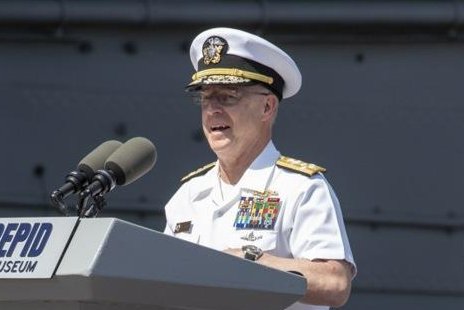
Adm. Daryl Caudle, the chief of Naval Operations, visited the Ulsan and Geoje shipyards in Korea Nov. 15 as pact to have Seoul take on some U.S. ship maintenance and construction moves ahead. File Photo by Sarah Yenesel/EPA
“MASGA” — a riff on the Trumpian slogan, aimed at Making American Shipbuilding Great Again — has officially weighed anchor. Yet, as the initial euphoria settles, a sober analysis suggests that the voyage toward success involves navigating a labyrinth of formidable obstacles.
The diplomatic framework is certainly in place. After formalizing shipbuilding cooperation in a joint U.S.-South Korea fact sheet, Adm. Daryl Caudle, the chief of Naval Operations, visited the Ulsan and Geoje shipyards Nov. 15.
His visit signaled that policy discussions are finally shifting into steel-cutting reality. Korean shipbuilders anticipate that “MASGA” will formally launch early next year, starting with maintenance, repair and overhaul for a U.S. naval vessel.
That procedure is the logical beachhead; it faces fewer regulatory hurdles than new ship construction. U.S. Secretary of Defense Pete Hegseth recently confirmed via a joint security consultive meeting communiqué on the Nov. 14 that a non-combatant vessel would soon be the first to undergo maintenance, repair and overhaul in South Korea. Given Korea’s history of servicing U.S. auxiliary ships, this is a natural progression.
Investment rush versus infrastructure reality
Sensing the opportunity, South Korean giants HD Hyundai and Hanwha Ocean are moving aggressively. HD Hyundai is mobilizing a $5 billion fund in partnership with Cerberus Capital Management and the Korea Development Bank, alongside a pledge to invest an additional $10.2 billion domestically by 2030.
Hanwha Ocean has committed more than $7.9 billion to shipbuilding and defense over the next five years, including the expansion at both its Geoje Okpo Shipyard and the Philly Shipyard.
However, capital alone cannot immediately fix the archaic state of American shipbuilding infrastructure. A look at the Philly Shipyard — chosen by President Donald Trump as a site for potential nuclear-powered submarine construction — reveals the magnitude of the challenge.
Currently, the yard’s two dry docks can barely accommodate mid-sized, 6,000 20-foot-equivalent unit container ships. It is entirely ill-equipped to handle the high-value liquefied natural gas carriers Washington desires.
To bridge this gap, Hanwha plans to construct two new docks and three quays, alongside a massive new block production base equipped with smart-yard automation and safety systems.
While the yard secured orders for one LNG carrier and 10 medium-sized tankers from its own affiliate, Hanwha Shipping, it lacks the immediate capacity to build them. Consequently, the LNG carrier must be built at Hanwha’s Geoje facility in Korea, and the tankers are not scheduled for delivery until 2029 due to these facility shortages.
One industry insider, who accompanied President Lee Jae Myung on his U.S. visit int August, admitted to being inwardly shocked after expecting facilities comparable to those in Geoje, noting, “The sheer amount of investment required seemed overwhelming.”
Ghosts of failures past
There is also the burden of history. South Korean shipbuilders have a poor track record when venturing abroad. Daewoo Shipbuilding (now Hanwha Ocean) famously struggled with the Mangalia Shipyard in Romania despite its large docks.
Productivity issues persisted despite low wages, and the yard was eventually sold. Similarly, Hanjin Heavy Industries’ ambitious Subic Shipyard in the Philippines collapsed and was sold to Cerberus in 2019.
The United States presents the opposite problem: astronomical costs. With apprentices at the Philly Shipyard reportedly earning at least $50,000 annually, the math of profitability becomes precarious.
Labor, legal minefield
Perhaps the most treacherous shoal is the human element. American labor unions are already bristling. The recent introduction of the “Ships for America Act,” which proposes relaxing the protectionist Jones Act, is viewed by unions as a death warrant for American jobs. Similarly, moves to amend the Byrnes-Tollefson Amendment to allow foreign construction of U.S. warships are meeting fierce resistance on national security grounds.
We have already seen how cultural and labor friction can disrupt operations, such as the recent tensions involving Korean workers at the Hyundai-LG battery plant in Georgia. Without preemptive legal frameworks to ensure smooth workforce integration, “MASGA” could face debilitating backlash.
Role of government: Financing, deregulation
Ultimately, the private sector cannot bear this burden alone. The proposed $150 billion investment into U.S. shipbuilding dwarfs the combined market capitalization of Korea’s “Big Three” shipbuilders. The government must step in with direct investment, guarantees and insurance.
Furthermore, the South Korean government must actively persuade Washington to modernize the Jones Act and the Byrnes-Tollefson Amendment. As long as these protectionist laws remain intact, full-scale cooperation will remain elusive.
An urgent need also exists for institutional alignment. While the White House has established a “Shipbuilding Office” via executive order, the South Korean presidential office lacks a direct counterpart. These bureaucratic mismatches may seem minor, but they are breeding grounds for future friction. The government should heed the recent call from HD Hyundai Vice Chairman Chung Ki-sun for specific government support.
A glimmer of hope
Despite the mountains ahead, there is precedent for flexibility. Trump recently approved the construction of icebreakers in Finland, proving that exceptions to the Jones Act are possible when strategic necessity demands it.
The course is charted. If Seoul and Washington can align their public and private sectors to move as one — navigating the regulatory and cultural storms with the same skill they apply to the high seas — the vision of rebuilding American shipbuilding is not just a slogan, but an achievable reality.
Nohsok Choi is the former chief editor of the Kyunghyang Shinmun and former Paris correspondent. He currently serves as president of the Kyunghyang Shinmun Alumni Association, president of the Korean Media & Culture Forum and CEO of the YouTube channel One World TV.
