

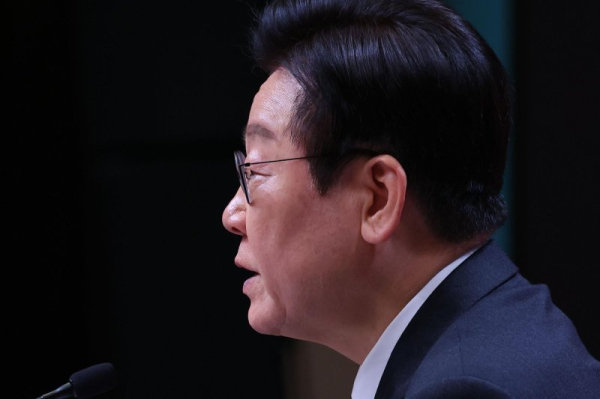
South Korean President Lee Jae Myung wants reopening of dialogue with Pyongyang, according to his remarks at the G20 summit, Photo by Yonhap News
South Korean President Lee Jae Myung has done something important. At the G20 in Johannesburg, he put peaceful reunification back on the global agenda and called it what it is for the Republic of Korea: a constitutional duty, not a vague aspiration.
He rejected reunification by absorption or force. He spoke of gradual, phased unification based on peaceful coexistence and mutual development, grounded in the democratic will of all Koreans.
He also asked President Donald Trump to play the role of peacemaker and pledged to coordinate closely with Washington while strengthening extended deterrence.
This is good news. But it raises two hard questions.
If peaceful unification is the end state, what is the plan to get there?
How can there be co-existence and respect for a political system that conducts horrendous human rights abuses against the Korean people in the North so that Kim Jong Un can remain in power?
Signals from Johannesburg
Lee’s remarks at the G20 sketched broad lines. He wants reopening of dialogue with Pyongyang. He says the door to talks will always remain open and that his government will respect the north’s political system and avoid any unilateral approach.
He rules out an indigenous nuclear weapons program. He prefers stronger extended deterrence with the United States, even as he seeks to avoid an arms race amid U.S.- China rivalry.
He points to deeper cooperation with partners such as Turkey in defense and nuclear energy as part of a broader strategy of stability and growth.
These are the contours of a posture. They are not yet a unification strategy. They do not explain how dialogue, deterrence and diversification will combine to change conditions inside the North or how they will empower the Korean people in the North rather than reinforce the Kim family regime.
Looking to Germany, again
Lee’s meeting with German Chancellor Friedrich Merz fit the same pattern. He asked for lessons from German reunification. He joked about a secret formula and was told there is none. Merz stressed strong bilateral ties and wanted to hear Seoul’s views on China and regional security.
There is nothing wrong with seeking German insights. But, Germany has been providing its “unification experience” to Seoul since 1991. There are shelves of books and dissertations that study every aspect of German unification, from macroeconomics to municipal finance.
The net effect in Korea has often been paralysis. The story of high costs and social friction has been used more to justify delay and risk avoidance than to spur strategic preparation for a free and unified Korea.
If Lee wants to break out of that paralysis, he must do more than ask Germany what it did. He must tell the Korean people, and the world, how his administration will pursue unification with the Korean people in the North, not with the Kim family regime that holds them hostage.
The vanishing 8.15 Unification Doctrine
This is where his government’s actions undercut his words. The Ministry of Unification has purged the 8.15 Unification Doctrine from its public website. The links no longer work.
The doctrine, a strategy for Korean Unification unveiled by then President Yoon Suk-yeol in 2024, has simply disappeared from official view. Yet, the administration has not articulated a new comprehensive unification plan to replace it.
The 8.15 Doctrine was not perfect. But it was an effort to set a strategic course toward a free and unified Korea. Erasing it without unveiling a superior framework sends the wrong signal. It tells the Korean people in the North that Seoul is less serious about a clear end state. It tells allies and partners that unification is back to being a slogan rather than a strategic objective.
If Lee rejects the 8.15 Doctrine, he owes the Korean people a better plan. If he does not have one ready, the prudent step is to recommit to 8.15, refine it, and keep it as a living guide until a more compelling and credible roadmap is presented.
Silencing one of the most important lines of effort
There is a deeper problem. The Lee administration, together with the U.S. administration, has effectively ended support for information broadcasts and other sustained information activities into North Korea. This shuts down one of the most critical lines of effort for any serious unification strategy.
Change in the North will not begin in regime elites in Pyongyang. It will begin in the minds of the Korean people in the north. They need access to truth, to outside information, to images of a different future. Information is the oxygen for new leadership to emerge inside the north that will seek peaceful unification on Korean terms, not on Kim family regime terms.
When Seoul and Washington dial back information campaigns, they unintentionally strengthen the regime’s control over the narrative. They reduce pressure on the Kim family regime. They weaken the long term prospects for a bottom up transformation that could make peaceful unification possible.
Human rights supported, but not upfront
There is also an unresolved contradiction in Lee’s approach to human rights. His administration supported the recent U.N. human rights resolution on North Korea. That is welcome. It signals that Seoul still cares about the suffering of the Korean people in the North.
Yet, at home, he has not adopted a human rights upfront policy toward the North. He prefers engagement and openings. He worries that a firm human rights policy might close the door to talks that are already frozen.
Kim Jong Un, however, is not seeking genuine engagement. He is pursuing his own political warfare and blackmail diplomacy strategy. He uses engagement as a tactic, not as a path to reconciliation. A policy built on the hope that he will open up if Seoul is softer on human rights is a policy built on illusion.
A real unification strategy must put human rights and human dignity at the center. It must treat the Korean people in the North as the main stakeholders in unification, not as bargaining chips in negotiations.
Recommendations: doctrine, information, a clear line
If Lee is serious about peaceful reunification as the ultimate goal, he needs to match words with strategy.
First, if he will not release a new, detailed unification plan in the near term, he should publicly recommit to the 8.15 Unification Doctrine. He can announce a review to update and improve it, but he should not leave a vacuum where doctrine once stood.
Second, he should restore and expand support for information activities into the North, in close coordination with the United States and like-minded partners. Radio, digital content, cultural products and civic connections are not optional. They are central tools for creating the conditions for political and social change inside the North.
Third, he should adopt a human rights upfront policy that treats the rights and dignity of the Korean people in the North as a strategic priority, not a secondary issue to be traded for meetings with Pyongyang. This will align Seoul with its own democratic values and with the aspirations of Koreans on both sides of the Demilitarized Zone.
Finally, he should give his policy a simple, memorable line that captures the right order of ends and means. Fourteen words can do it.
“Unification first, then denuclearization; the path to unification is through information and human rights.”
If Lee would adopt this as his guiding principle and align his doctrine, broadcasts and human rights policy with it, then his good words in Johannesburg could become the starting point for a real strategy to achieve a free and unified Korea.
David Maxwell is a retired U.S. Army Special Forces colonel who has spent more than 30 years in the Asia Pacific region. He specializes in Northeast Asian security affairs and irregular, unconventional and political warfare. He is vice president of the Center for Asia Pacific Strategy and a senior fellow at the Global Peace Foundation. After he retired, he became associate director of the Security Studies Program at Georgetown University. He is on the board of directors of the Committee for Human Rights in north Korea and the OSS Society and is the editor at large for the Small Wars Journal.
