

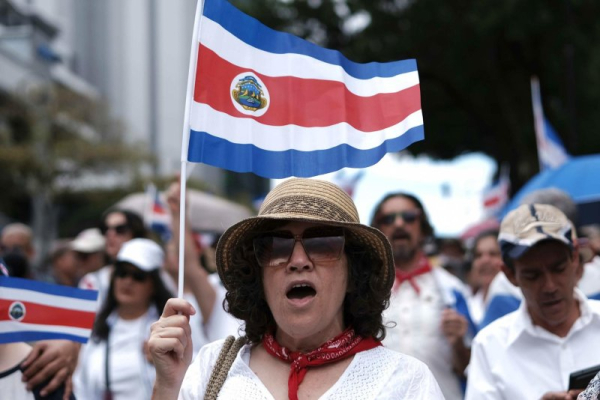
A new geopolitical concept, “Greater North America,” is beginning to take shape in Washington, and Costa Rica should pay attention to it. File Photo by Jeffrey Arguedas/EPA
A new geopolitical concept is beginning to take shape in Washington, and Costa Rica should pay attention to it.
The idea is called “Greater North America.” It is not a treaty, a legal framework or a formal international organization. It is a strategic doctrine associated with recent statements by Pete Hegseth, secretary of the Department of Defense, and with the broader security outlook of President Donald Trump’s administration.
Speaking at the inaugural Americas Counter Cartel Conference at U.S. Southern Command headquarters in Doral, Fla., on March 5, Hegseth said Trump had “reestablished the Monroe Doctrine,” and announced that the Pentagon now calls the region north of the equator “the Greater North America.”
A redrawn map
Hegseth described a zone stretching from Greenland to Ecuador and from Alaska to Guyana, covering every sovereign state and territory north of the equator. In his words, this area is not part of the “Global South,” but forms the United States’ “immediate security perimeter.”
That language signals a sharper distinction between countries Washington sees as part of its near strategic neighborhood and those it treats as part of a more distant global contest. It also reflects a return to hemispheric thinking, with a strong emphasis on borders and cartel violence, as well as the growing influence of China and Russia in the region.
Where Costa Rica fits
From Costa Rica’s standpoint, the concept has an obvious logic. Our country sits between Nicaragua to the north and Panama to the south. Nicaragua has deepened its ties with China and Russia in recent years. Panama occupies a vital place in global trade because of the canal.
For Washington, that makes Central America more than a peripheral zone. It becomes part of a corridor of direct strategic interest.
Costa Rica, therefore, appears likely to be viewed less as a distant small state and more as a relevant player in a sensitive belt connecting North America to the Caribbean and the northern edge of South America. For a country with no military and a long democratic tradition, that shift could create both opportunities and pressure.
Real opportunities, real risks
The opportunities are genuine. If Costa Rica is increasingly seen as part of a priority strategic space, it could benefit from closer cooperation with the United States on port security, cyber defense and anti-cartel efforts, and strengthen its case as a trusted democratic partner at a time when Washington is looking for dependable relationships in its immediate neighborhood.
The administration’s actions in Venezuela show that this is not just rhetorical repositioning. On Jan. 3, U.S. special operations forces conducted a military raid on Caracas, capturing President Nicolás Maduro and his wife at a compound inside Venezuela’s largest military base.
Maduro was flown to New York, where he faces narco-terrorism charges. Delcy Rodríguez assumed the acting presidency, and Washington has since sought to normalize relations with her government, lifting sanctions on Rodríguez on Thursday.
Those developments help explain why smaller countries should take Washington’s new hemispheric language seriously. The United States is signaling it intends to define threats in the Americas more aggressively and to respond with fewer inhibitions than in recent years.
Still, a doctrine built around U.S. security priorities can easily create tensions for smaller nations. It may invite pressure to align more closely with Washington’s strategic agenda, even when local interests are more nuanced, and it raises legitimate concerns about sovereignty and the proper limits of U.S. influence in the hemisphere.
Responding wisely
Costa Rica must approach the concept with realism. We should neither dismiss it as mere rhetoric nor embrace it uncritically. Our task is to understand how this new map is being drawn and to decide where Costa Rica’s own interests lie within it.
That means engaging the doctrine pragmatically without surrendering our own identity. Our democratic institutions, civilian tradition and credibility in international affairs are assets that no external doctrine can replace. It also means avoiding simplistic ideological readings.
Hegseth’s speech framed the hemisphere in civilizational terms, describing the region’s countries as heirs to a shared Western and Christian heritage. That language may resonate in some circles, but U.S. policy will ultimately be judged by outcomes: whether it improves security and respects the independence of partner states.
Geography will not change. Costa Rica will remain part of Central America, close to the canal, close to Nicaragua and closely linked to the U.S. economy. We are already inside the strategic picture Washington is drawing. The real issue is how wisely we respond.
Greater North America may never become a formal doctrine in the classic sense. Yet, as a strategic lens, it already reveals how the current U.S. administration sees the hemisphere. Costa Rica should study that vision carefully, weigh its promise against its risks and respond from a position of democratic confidence rather than passivity.
Óscar Álvarez Araya is a political scientist and former Costa Rican ambassador to Taiwan. The views and opinions expressed in this commentary are solely those of the author.
