


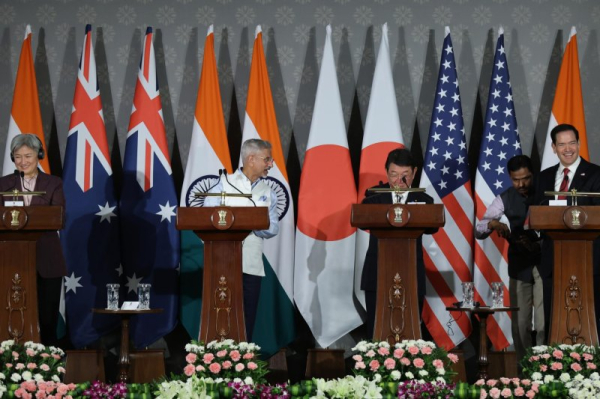
(L-R) Australian Foreign Minister Penny Wong, Indian Minister of External Affairs Subrahmanyam Jaishankar, Japanese Foreign Minister Toshimitsu Motegi and U.S. Secretary of State Marco Rubio attend a joint press conference following the Quad Foreign Ministers’ Meeting in New Delhi, India, on May 26. File Photo by Rajat Gupta/EPA
Contrary to recent scholarship characterizing the Quadrilateral Security Dialogue as languishing or strategically irrelevant, the recent Quad Foreign Ministers’ Meeting in New Delhi confirms that the grouping is successfully evolving into a practical instrument of regional stabilization rather than a purely declaratory alignment.
Geopolitical tensions, energy insecurity, and supply chain disruptions are placing pressure on the Indo-Pacific, sharpening the Quad’s focus on practical cooperation. The outcomes of the New Delhi summit signal a clear shift toward functional initiatives, reinforcing the group’s position as a vital provider of public goods in a contested strategic environment.
The joint statement reflects a consistent baseline: a firm commitment to a rules-based order grounded in international law, sovereignty, and the peaceful resolution of disputes. In reaffirming clear opposition to unilateral attempts to change the status quo by force or coercion, the four partners maintain a position that is simultaneously normative and strategic.
The New Delhi meeting highlights that the Quad’s long-term credibility depends entirely on its ability to deliver concrete outcomes. The agreement to deepen cooperation on energy security and critical minerals responds directly to systemic vulnerabilities exposed by recent instability in the Middle East and persistent supply chain concentration.
Because the Indo-Pacific remains highly exposed to disruptions in energy flows, with cascading effects on global food and fertilizer security, the Quad’s decision to establish coordinated energy security mechanisms is a necessary step toward enhancing regional resilience.
Similarly, the focus on critical minerals reflects a recognition that supply chain security is now a central pillar of strategic competition. By mobilizing investment and aligning economic policy tools, the Quad seeks to diversify sourcing, reduce exposure to single suppliers, and counter distortive market practices.
This initiative represents an attempt to construct a “Pax Silica” — a stabilizing industrial and technological order built on secure access to semiconductors, rare earths, and the critical inputs underpinning the digital economy.
Rather than pursuing an abrupt and economically damaging decoupling, the Quad is building parallel, trusted ecosystems. If successful, this architecture will reduce systemic dependence on China while reshaping the long-term distribution of technological power in the Indo-Pacific.
Maritime security remains the connective tissue linking these economic and technological efforts. Because the Indo-Pacific is central to global trade, any disruptions — whether from state conflict, coercive maneuvers, or regulatory overreach like arbitrary passage restrictions — carry global economic consequences.
The Quad’s explicit opposition to passage fees in pivotal chokepoints, such as the Strait of Hormuz, alongside its emphasis on freedom of navigation under UNCLOS, directly reinforces shared global norms.
Beyond rhetoric, the expansion of maritime domain awareness and surveillance cooperation illustrates how the Quad translates principles into operational capacity. These enhanced monitoring capabilities provide tangible, real-time benefits not only to Quad members but to smaller regional partners with limited maritime enforcement capabilities.
This outward-facing dimension is critical to understanding the Quad’s stabilizing function. Rather than acting as an exclusive, closed bloc, the grouping functions as an open platform for delivering public goods — ranging from maritime tracking to infrastructure support and disaster response.
These initiatives build local capacity without demanding rigid geopolitical alignment, ensuring that smaller states retain their strategic agency and access to alternative partnerships. Consequently, the Quad’s approach complements, rather than competes with, existing regional architecture like ASEAN.
The evolution visible in New Delhi suggests the institutionalization of “functional minilateralism” tailored to the Indo-Pacific. Its flexibility — remaining outside formal, rigid alliance structures — allows it to respond to emerging challenges with a speed and pragmatism that larger multilateral institutions often lack. In this respect, the Quad’s trajectory directly challenges recent analytical narratives that question its cohesion and long-term viability.
To consolidate its role and sustain momentum across this expanding agenda, the Quad must now execute several critical strategic adjustments.
First, energy cooperation needs to move beyond mere policy coordination into operational, rapid-response mechanisms capable of actively mitigating sudden supply disruptions.
Second, the critical minerals initiatives underpinning the emerging Pax Silica framework must expand geographically. By integrating trusted third-country partners into semiconductor and rare earth supply chains, the Quad can ensure that diversification yields genuine global resilience rather than a partial, regional realignment.
Additionally, maritime cooperation should continue to scale by integrating advanced technological capabilities with localized capacity-building. Sustained engagement with ASEAN and Pacific Island nations remains essential to ensure that Quad initiatives are perceived as inclusive and responsive to local needs, rather than as frameworks externally imposed by great powers.
Ultimately, the New Delhi meeting reinforces a core insight: the Quad’s enduring strength lies less in its potential as a hard military counterweight and more in its function as a stabilizing mechanism. By focusing on the steady provision of public goods — energy resilience, secure supply chains, and open sea lanes — it systematically addresses the structural vulnerabilities of the regional order.
Erik Lenhart ([email protected]) holds an MA in political science from Charles University. He is a former Deputy Chief of Mission of the Slovak Republic in Tokyo and the author of the award-winning novel Daughters of the Empire. Michael Tkacik ([email protected]) holds a PhD from the University of Maryland and a JD from Duke University. He is a professor of government and director of the School of Honors at Stephen F. Austin State University, the University of Texas system. This article is republished with permission from the South China Sea NewsWire. Read the original article.
