


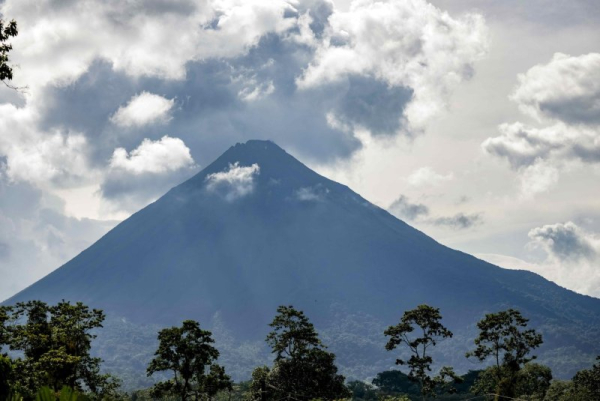
Costa Rica has received another favorable review from the International Monetary Fund, which is welcome news for the country’s economy. File Photo by Jeffrey Arguedas/EPA
Costa Rica has received another favorable review from the International Monetary Fund. For a country long regarded as one of Latin America’s most stable and better-managed economies, that is welcome news.
But the real message of the IMF’s 2026 Article IV report is not simply that Costa Rica is doing well. It is that Costa Rica must not confuse stability with safety.
The country has built important strengths. It has reduced fiscal risks, attracted foreign investment and maintained a reputation for institutional seriousness in a region often marked by volatility. Yet the IMF’s report also makes clear that Costa Rica’s future will depend less on the achievements already made than on the reforms still pending.
For Costa Ricans, the report should be received with pride, but not with complacency. The central challenge is not an immediate economic collapse. It is something more subtle: the danger of postponing difficult decisions because the present still appears manageable.
Growth with limits
The IMF estimates that Costa Rica grew about 4.6% in 2025, well above the Latin American average. That performance is especially notable because it was not driven by a commodity boom or a surge in public spending. Costa Rica’s growth rests largely on foreign direct investment and the macroeconomic stability built in recent years.
High-value export sectors, including medical devices, advanced manufacturing and business services, have helped position Costa Rica as one of Latin America’s most attractive investment destinations. The country has become deeply integrated into global value chains. Yet this success also contains one of Costa Rica’s most serious structural weaknesses.
The benefits of growth are not distributed evenly. Highly productive sectors connected to international markets have advanced rapidly, while many domestic sectors continue to struggle with lower productivity and limited opportunities.
This dual economy is not only an economic problem. It is a social and political challenge. A country can show strong national growth figures while many citizens still feel excluded from the prosperity those figures describe.
Fiscal discipline is only the beginning
The same is true of Costa Rica’s fiscal situation. The country deserves credit for restoring discipline to public finances. During the previous decade, rising spending and growing public debt generated serious concern. Reforms adopted in recent years, especially the fiscal rule, helped contain spending and reduce the debt-to-GDP ratio.
That achievement matters. Fiscal discipline is not an abstract technical goal. It is what gives a country room to respond to crises and invest in long-term priorities.
But fiscal consolidation cannot mean simply spending less. Costa Rica now needs to spend better. The next stage of the national debate must focus on how to create space for strategic investment without putting public finances at risk again. Without that discussion, fiscal discipline can become a ceiling rather than a foundation for development.
Demography and security cannot wait
The most urgent warning concerns demography. Costa Rica’s population is aging rapidly. Fertility has fallen while life expectancy has risen. These trends reflect advances in human development, but they place growing pressure on pensions and health care.
The IMF warns that, under current conditions, the reserves of the disability, old age and death pension regime could be depleted within the next decade. It also points to growing financial stress in the health system administered by the Costa Rican Social Security Fund.
Costa Rica’s demographic transition is moving quickly, and delay will only make eventual reforms more painful. Pension and health care reform are politically sensitive, affecting workers and retirees across the public and private sectors alike. But avoiding the subject does not protect the public. It merely transfers the burden to the next generation.
The IMF report also highlights an issue that would once have seemed outside the normal boundaries of macroeconomic analysis: citizen security.
Costa Rica’s rising crime and homicide rates are no longer only a public safety concern. They are also an economic risk. Insecurity discourages investment, raises business costs and damages the international image of a country long known for peace and stability.
Costa Rica’s reputation has been one of its greatest national assets, drawing investors and visitors alike. If organized crime continues to gain ground, that reputation could erode faster than many policymakers imagine. Security, therefore, must be understood as part of the national development agenda. Strengthening the state’s capacity to combat organized crime is not a distraction from economic policy. It is now one of its essential conditions.
Building the next stage of development
The IMF’s report also flags weaknesses in infrastructure, education and labor markets. Gaps in roads, technical training and workforce participation continue to constrain competitiveness. For a country whose success depends heavily on its ability to attract investment and connect with global markets, these are not minor administrative problems. They are obstacles to the next stage of development.
These concerns will determine whether Costa Rica’s growth model becomes more inclusive or remains concentrated in a few highly successful sectors. Given the country’s limited fiscal space, progress will increasingly depend on targeted reforms and private-sector partnerships, rather than public expenditure alone.
Stability must become reform
The IMF has offered a broadly positive assessment. In a difficult international environment, Costa Rica continues to stand out for institutional credibility and economic resilience.
But praise can be dangerous if it encourages self-satisfaction. Costa Rica’s real test is not whether it can win approval from international organizations. The real test is whether its political system can act before today’s warnings become tomorrow’s crisis.
The IMF has done its part by offering a diagnosis. The responsibility now belongs to Costa Rica’s elected leaders, who must decide whether to act while the country still has room to maneuver.
The country has earned its reputation as one of Latin America’s most successful democracies. The question now is whether it can renew that success before the pressures beneath the surface become too large to ignore.
Stability is a national asset. It should not become an excuse for delay.
Óscar Álvarez Araya is a political scientist and former Costa Rican ambassador to Taiwan. The views expressed are solely those of the author.
