


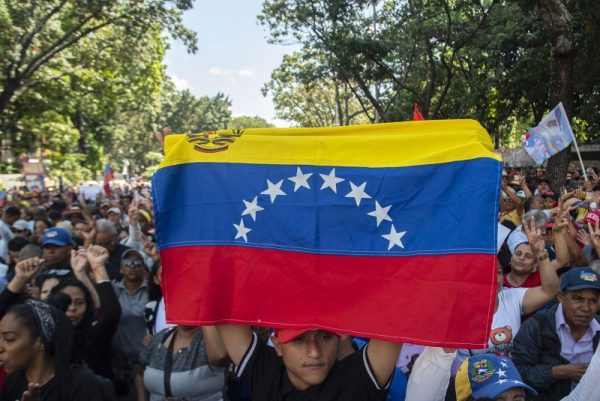
If Venezuela is to recover as a free and democratic society, it must also be rebuilt in the classroom. File Photo by Jonathan Lanza/UPI | License Photo
Venezuela’s future will not be rebuilt by oil alone. It will not be rebuilt through elections or diplomatic negotiations, however necessary those are. If the country is to recover as a free and democratic society, it must also be rebuilt in the classroom.
That argument gained international attention on May 12, when Nobel Peace Prize laureate María Corina Machado delivered the keynote address at a Harvard University conference on education and the country’s future. Education, she told the audience, is not a downstream consequence of political change. It is one of the forces that makes political change possible.
I know this not only from research, but from memory.
Until 2020, I attended high school in Coro before moving to the United States. My experience was marked by absence. Many teachers had emigrated. There was no student library and no functioning public library nearby. Water and electricity were unreliable. There was no cafeteria or nurse’s office. These were not minor inconveniences. They were signs of a system that had ceased to provide the basic conditions for learning.
That reality is still shared by millions of children in a country that once took pride in its human talent and professional class.
The data shows how deep the damage has become. According to UNICEF, roughly 3 million children and youth are currently out of school in Venezuela, with many more at risk of dropping out. Around 200,000 teachers have left their posts. Those who remain often work only a few days a week in schools that, according to the National Survey of Educational Establishments, lack reliable electricity in 70% of cases and running water in more than half.
The learning crisis is just as severe. A 2021 baseline study found that 68% of students showed reading fluency delays, averaging 64 words per minute, below the target of 85 to 90. The Andrés Bello Catholic University’s national assessment for 2023-2024, based on nearly 10,000 tests, found that more than 70% of students from sixth grade through secondary school failed minimum competency in reading comprehension. The mathematics failure rate in public schools exceeded 92%.
Behind these numbers is the teacher crisis. The Venezuelan Teachers’ Federation estimates the average public school teacher earns around $15 per month, while a basic food basket costs hundreds of dollars. Commitment cannot substitute for a livable wage. A country that asks teachers to form citizens while paying salaries that cannot sustain a family is undermining its own future.
For my generation, Venezuela is not only a crisis to study from a distance. It is a country whose future still feels unfinished. Many of us grew up hearing what it once was while watching families leave and children inherit a nation they did not break. The question is whether they will also inherit the tools to rebuild it.
The collapse of the education system is not a secondary consequence of the national crisis. It is one of the clearest signs of how deeply that crisis has entered the country’s life. When a child cannot read at grade level, the consequences persist into adulthood, narrowing opportunities and weakening the capacity to participate in public life.
This matters because democracy depends on more than institutions. It depends on citizens who can think freely and read critically. A nation cannot rebuild constitutional democracy while allowing its schools to remain broken.
Machado’s education plan, presented at Harvard, organizes reconstruction around urgent school reopening, teacher salary restoration and the use of artificial intelligence to support learning recovery. It also includes an education voucher system that allows public funding to follow students.
“Venezuela will be the first nation rebuilt from zero in the era of artificial intelligence,” Machado told the audience. “That gives us the opportunity to make a great leap forward across every sector.” Whatever one’s view of her broader political program, the diagnosis holds: the country cannot wait for education to recover slowly after democracy returns. Education must be part of how democracy returns.
Technology may help, but it cannot replace the human work at the center of education. Children need safe classrooms and food, because hunger makes learning nearly impossible. Teachers need salaries that allow them to remain in their profession. Students who have fallen behind need honest measurement and patient recovery, beginning with reading and mathematics.
Schools must also prepare students to live as citizens in a free republic. That requires civic education rooted in human dignity. It also requires a curriculum free from political indoctrination and honest about what the past 27 years actually were.
After authoritarian rule, schools do not return to normal simply by opening their doors. They must help a new generation understand what happened and why institutions matter. Education reform is a transitional justice obligation as much as a reconstruction priority. Teachers punished for dissent deserve restitution. Students who grew up under fear deserve truth.
The diaspora has a concrete role to play. Millions of citizens live outside the country, including many former educators who dream of returning to help rebuild. The international community can contribute, but the work must be led by Venezuelans. A democratic future cannot be imported.
The country has endured one of the gravest national collapses in modern Latin American history. Yet its future remains open. It possesses extraordinary human talent, a diaspora spanning more than 90 countries and a generation of young people who deserve more than survival.
If Venezuela is to become free, it must learn again. If it is to become democratic, its children must be taught to think without fear. And if it is to become whole, the classroom must be treated not as an afterthought of reconstruction, but as one of the places where the republic begins again.
Daniela Fonseca, a Venezuelan graduate student at Yale University and Jack Kent Cooke Foundation scholar, conducts research on education, transitional justice and democratic reconstruction in her country.
